
Big Book Journey
- The Journey Starts - Home Page
- Forewords to 1st + 2nd Editions
- The Doctor's Opinion pages xv - xiv
- Chapter 1 - Bill's Story pages 1 - 16
- Chapter 2 - There Is A Solution pages 17 - 29
- Chapter 3 - More About Alcoholism pages 30 - 43
- Chapter 4 - We Agnostics pages 44 - 57
- Chapter 5 - How It Works pages 58 - 71
On this walk through the first chapter of the Big Book I determined not to make the end of the chapter the goal, but instead take time to explore, kick over rocks, wander off the the trail, and ponder on what I would discover. The explorations included phrases and word meanings common in the 1930's but not so much today. This led to the story behind the story, which presented a better appreciation of the individuals and events of the era when the book was writen. An academic understanding will not bring change in my life but my honesty, open mindedness, and willingness will.
The following resources were used:
- Quotes from the Big Book are from the public domain version, in the United States, of the 2nd edition of the book Alcoholics Anonymous. This is accessible at 12step.org
- Sentence diagramming, to determine the word usage within the sentence, was performed by CoreNLP at corenlp.run.
- Definitions used are from the Webster's New International Dictionary of the English Language 1930 Edition
- An idiom is a phrase or expression that has a symbolic meaning different from the literal interpretation of the words. For idioms not listed in the 1930 Webster's Dictionary the Farlex Dictionary of Idioms was used.
- 164 and More - a Concordance of the Big Book and the 12 & 12 was used to refer to the multiple instances word use within the book. A hardcopy version is available for purchase and also a free on-line version.
- Most historical information was gleaned from:
"Bill W." by Robert Thomsen (1975)
"Bill W." by Francis Hartigan (2000)
"The Lois Wilson Story" by William Borchert (2005)
"Writing the Big Book" by William Schaberg(2019)
Historical Background for the first part of Chapter 1
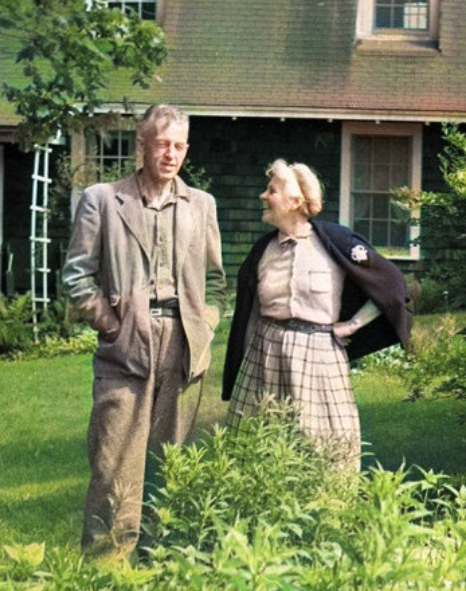
On June 28th of 1914 the Archduke Franz Ferdinand of Austria was assassinated. This one act resulted in a series of events that started WWI. That fall Bill Wilson, of Dorset, Vermont, became a student at Norwich University. Norwich was a small military college in Northfield Vermont and Bill began his college education with the intent of studying Engineering. That summer in Dorset, Bill met Lois Burnham, a Brooklyn lady spending the summer at her families summer home in Manchester, Vermont. Their relationship outlived the summer, and bloomed over the next years with many visits and letters. Bill returned to school, where he struggled with subjects, but excelled in his military subjects. Lois began teaching at a school in New Jersey owned by her aunt.
As events unfolded in Europe and various countries entered the war, the United States initially observed from a distance and hesitated to get involved. Germany implemented a maritime blockade of Britain, allowing only one U.S. ship to safe passage to England each week. The turning point in U.S. public opinion came when a secret encoded telegram from Germany to Mexico. This telegram, now known as the Zimmermann Telegram, was decoded and then published in the United States. In the message Mexico was promised the territories of Texas, Arizona, and New Mexico if they agreed to ally with Germany in the conflict. This revelation sparked widespread fear across the U.S. In response, President Wilson called a special session of Congress. The session resulted in the United States formally declaring war on Germany. On April 6, 1917, the U.S. joined the Allied forces against Germany.
In response to the national crisis, Norwich University canceled all academic classes, directing cadets to focus entirely on military drills. Within a few weeks, many cadets, including Bill, volunteered to join the army. The Norwich men were organized into a Reserve Officers' Training Corps (R.O.T.C.) unit and were immediately sent to Plattsburgh, New York, for training. After completing their training, Bill had the opportunity to choose his branch of service from four options. He selected the Coast Artillery and departed that night for Fort Monroe, Virginia, where he underwent eight weeks of field artillery training. Upon completing the training, 22-year-old Bill earned the rank of Second Lieutenant. His next duty station was Fort Rodman in Massachusetts. At Fort Rodman, the affluent Grinnell family hosted weekend events for soldiers at their estate in New Bedford. Bill later recalled these gatherings as the place where he discovered that Bronx Cocktails helped alleviate his chronic social anxiety.
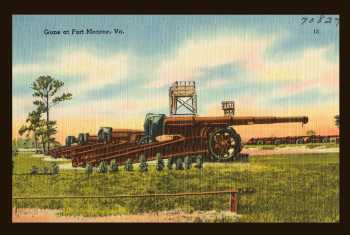
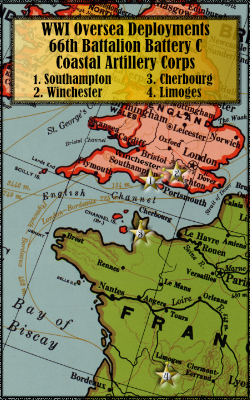
for the Coastal Artillery Corps during WWI
Bill and Lois planned to get married in February, but they decided to change the date due to increasing rumors about his impending deployment to Europe. The couple was married in a small ceremony at the Swedenborgian Church in Brooklyn, on January 24, 1918. Lois had grown up in this church, her grandfather a respected Swedenborgian minister and author. The couple made a brief trip to Boston to visit his mother and sister. Back in New Bedford, Bill rented an apartment outside the base for Lois and himself. In April, his unit transferred to Fort Adams in Newport, Rhode Island, marking the beginning of his journey to war.
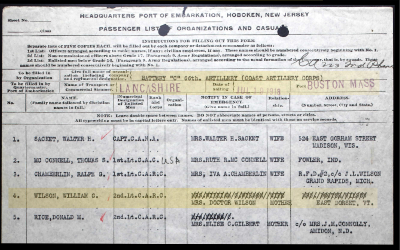
Troops stationed at Fort Adams were waiting for the ships that would transport them from Boston to Europe. Since Bill was required to live on the base, Lois rented a room at a nearby boarding house. Bill and Lois devised a code in his letters to her, when he signed the letter Billy, she would know he was still in a safe location. On July 18, the ship named Lancashire departed from Boston Harbor bound for Southampton, England. Lois returned to Brooklyn while Bill's 66th Battalion Coastal Artillery Corps Battery C was sent to camp just outside of Winchester, England, waiting for it's journey to France. The unit was held longer than the rest of the Battalion, due to an epidemic within the camp. This delay allowed Bill a pass to explore Winchester.
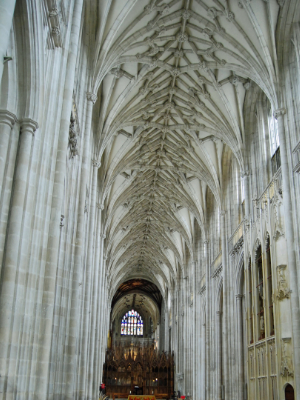
In August, Bill took a walk and found himself at the town's cathedral. As he walked down the aisle, he stood enveloped in a beam of colored light streaming through a stained glass window. Inspired by the beauty, he sat alone and experienced a profound sense of peace in the complete silence. As he was leaving the grounds, he paused to view the grave of the Hampshire Grenadier, with which he uses the inscription from to begin his story in Chapter One.5
During this time, Lois tried to join Bill in France, volunteering for a program the Young Men's Christian Association (Y.M.C.A.) organized to send women trained in occupational therapy to aid injured front-line U.S. troops. However, the Y.M.C.A. rejected Lois because they did not consider her childhood religious upbringing in the Swedishbortian community an acceptable Protestant denomination.
Battery C arrived at Cherbourg-en-Cotentin, France on 19 August 1918. They were assigned to Services of Supply and then moved on to Limoges, in west-central France, where they rejoined the rest of the 1st Battalion, which remained until the Armistice. By the time Bill had arrived in France, the war was winding down. His unit never saw combat but by he had become a heavy drinker. The regiment remained in France until it shipped back to the United States on March 8, 1919. The Battalion was demobilized at Camp Upton, on Long Island, New York, on March 29, 1919 and Bill was discharged. Upon discharge his men gave him a watch in appreciation of his leadership. He reunited with Lois at her family home at 128 Clinton Street in Brooklyn. 6
Background Definitions for Bill's Story - Chapter 1
The Hampshire Grenadier
My attention was caught by a doggerel on an old tombstone:
"Here lies a Hampshire Grenadier
Who caught his death
Drinking cold small beer.
A good soldier is ne'er forgot
Whether he dieth by musket
Or by pot."
Ominous warning--which I failed to heed."
1
Big Book - Bill's Story - page 1

A doggerel is a loose or irregular in measure verse - it this case the verse on the grave marker is hard to read in rhythmic way.
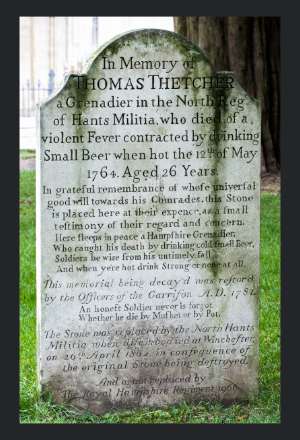
on the grounds of Winchester Cathedral in Winchester, England
photo by Andy Morffew - under Public Domain License
The Hampshire Grenadier
A grenadier was a soldier who carried and threw grenades. The Hampshire Grenadier refers to Thomas Thetcher. Notice his last name is similar to but not spelled the same as Bill's childhood friend Ebby Thatcher. His biography "Bill W." says the similarity between the names is what first drew Bill's attention to the marker. Thomas Thetcher n served in the North Hants Militia of Hampshire, England. This militia unit was only activated when the need arose, much like a state national guard unit is in the United States today. Research of North Hants Militia indicates it was not in an activated status when Thomas died on 12 May 1764. Thomas was 26 years old at the time of his death.
Bill's recall of the "doggerel" text on the marker varies from the actual gravestone. The actual inscription is:
Here sleeps in peace a Hampshire Grenadier,
Who caught his death by drinking cold small Beer,
Soldiers be wise from his untimely fall
And when ye’re hot drink Strong or none at all."
An Honest Soldier never is forgot
Whether he die by Musket or by Pot.
What is Small Beer? - In 1764 proper sanitation methods were not yet understood. A lack of clean drinking water in populated areas was rare in both England and Colonial America. Most drinking water was contaminated with cholera, typhoid, and other bacterial organisms. It was common to brew a beer with a low alcohol content as the substitute for contaminated drinking water. The brew was usually made at home, and referred to as Small Beer, as opposed to Strong Beer. When prepared correctly Small Beer would kill water-borne organisms but not make a person drunk. It was also consumed by children as the safe alternative to drinking possible contaminated water. Once clean drinking water did become available the drinking of Small Beer was no longer required to stay healthy and the practice gradually stopped. The original gravestone contains the warning, if you are thirsty make sure you drink "Strong beer". This refers to Beer with enough alcohol content that it could make you intoxicated, which ensured bacterial contamination was eliminated. We can guess from the gravestone text that Thomas drank beer that was too low in alcohol content, and contained bacterial contamination. This resulted in him contracting a bacterial infection which caused a high fever and ultimately his death. The last thought of the original verse states the memory of an honest soldier is not forgotten regardless of the cause of his death. The use of the word "pot" does not refer to modern slang for marijuana, but instead to the container holding the beer.
In conclusion, Bill did not understand the actually meaning of the inscription. His interpretation sent him a warning of the danger of his acquired drinking habits. So why does Bill's version of the epitaph differ from the original? We can only speculate. In the biographies "Bill W.", it places his visit to Winchester Cathedral to a day in August 1918. Small cameras were not yet available, so it was unlikely Bill would have taken a photo. He may have been relying on his memory or he may have intentionally altered the verse to better fit his writing purpose and style.


"I took a night law course, and obtained employment as investigator for a surety company"
1
Big Book - Bill's Story - page 2
In this sentence investigator and surety are used as a noun. 2
A surety company is a business that issues bonds (insurance) to ensure that a third party (the principal) will fulfill its obligations. For example, when a city puts out a bid for a water treatment facility, the city requires the contractor (the principal) to purchase a surety bond (insurance) before starting the project. This bond (insurance) gives the city a guarantee they will be reimbursed (by the surety company) for any damages they incur if the contractor fails to complete the project in accordance with the terms of the contract.
Returning from World War I, Bill secured a job as an investigator for the United States Fidelity and Guaranty Company (USF&G), an insurance company which issued guaranty bonds. Bill investigated claims that were suspected as fraudulent. At the same time, he attended night law classes at the Brooklyn School of Law. He did complete the law course but never practiced law. 6


"We had long talks when I would still her forebodings by telling her that men of genius conceived their best projects when drunk; that
the most majestic constructions philosophic thought were so derived."
1
Big Book - Bill's Story - page 2
In this sentence forebodings, men, and genius are used as nouns. The words majestic and philosophic are used as adjectives. The word constructions is used as a plural noun. 2
The phrase "man of genius" refers to a person with extraordinary intellectual power.
"The phrase majestic constructions of philosophic thought" refers to grand, complex, and impressive philosophical ideas or theories that are considered to be highly developed, profound, and intellectually awe-inspiring, often signifying a significant advancement or landmark in the field of philosophy. 7


The inviting maelstrom of Wall Street had me in its grip."
1
Big Book - Bill's Story - page 2
In this sentence maelstrom is used as a noun. 2
Wall Street is a street in New York City that is the financial center of the United States. The term "Wall Street" is used as a symbolic term for the US financial industry.

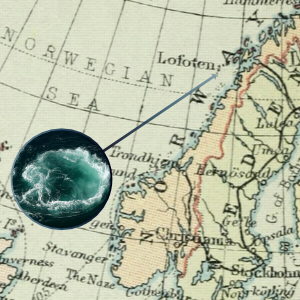
is a system of tidal eddies and whirlpools, the largest in the world.
Located between the island of Moskenesøya and the island of Mosken.

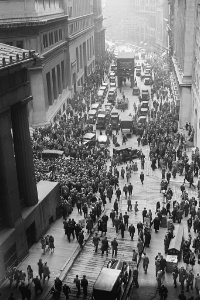
the New York Stock Exchange Building is on the right.
Out of this ally of drink and speculation, I commenced to forge the weapon that one day would turn in its flight like a boomerang and
all but cut me to ribbons."
1
Big Book - Bill's Story - page 2
In this sentence ally, boomerang, and ribbons are used as nouns, the word forge is used as a verb. 2
The symbolism of a boomerang originates from Bill's childhood experience of designing and learning to throw one. He crafted the boomerang using the wood from the headboard of his bed, which delighted his grandfather but not so much his grandmother. 6


It went into certain securities, then cheap and rather unpopular."
1
Big Book - Bill's Story - page 2
In this sentence securities is used as a noun. 2
A security is a financial instrument or certificate that has monetary value and can be traded. Examples are bonds, stocks, notes, etc...

The great boom of the late twenties was seething and swelling."
1
Big Book - Bill's Story - page 3
In this sentence boom is used as a noun. Seething and swelling are both used as verbs. 2
"The great boom of the late twenties" refers to the decade of the "Roaring Twenties". This is a period that began after the end of World War I and concluded with the onset of the Great Depression. During these years, the populations of American cities outgrew the agricultural population, automobiles replaced horses as the main mode of transportation. The period is remembered for it's optimism, prosperity, the birth of jazz, and the widespread defiance of alcohol prohibition. Furthermore, the passage of the 19th Amendment in 1920 granted women the right to vote for the first time in the United States.


The exercise of an option brought in more money, leaving us with a profit of several thousand dollars for that year."
1
Big Book - Bill's Story - page 3
In this sentence option is used as a noun. 2
A stock option is not a share of stock. Instead, it is an agreement allowing the holder of the option to purchase stock shares at a predetermined price and by a specified date.

Everyone spent in thousands and chattered in millions."
1
Big Book - Bill's Story - page 3
In this sentence chattered is used as a verb. 2

Scoffers could scoff and be damned."
1
Big Book - Bill's Story - page 3
In this sentence scoffers is used as a noun, scoff is used as a verb. 2

I made a host of fair-weather friends."
1
Big Book - Bill's Story - page 3
In this sentence fair is used as an adjective, and weather is used as a noun. 2

The remonstrances of my friends terminated in a row and I became a lone wolf."
1
Big Book - Bill's Story - page 3
In this sentence fair is used as an adjective, and weather is used as a noun. 2
The idiom "lone wolf" originates from wolf behavior, it refers to an animal that acts independently or generally lives or spends time alone instead of with a group. A lone wolf in winter hunts and fends for itself. See see lone wolf trait. 4 Webster's definition states lone is from the word alone, then refers to the word solitary, meaning isolation. The disease of alcoholism isolates those engulfed by it.


"We went at once to the country, my wife to applaud while I started out to overtake Walter Hagen."
1
Big Book - Bill's Story - page 3
In 1929 Bill and Lois returned to Vermont. Concerned about his drinking and increasing bouts of depression, he took up golf in an attempt to improve his health. Bill played every day at the Ekwanok Country Club in Manchester, sometimes three rounds a day. Growing up nearby, Bill was very familiar with the 18-hole course. Todd Lincoln, the son of President Abraham Lincoln, served as the club's long-time president, making it a popular meeting place for the elite residents of Manchester. 6
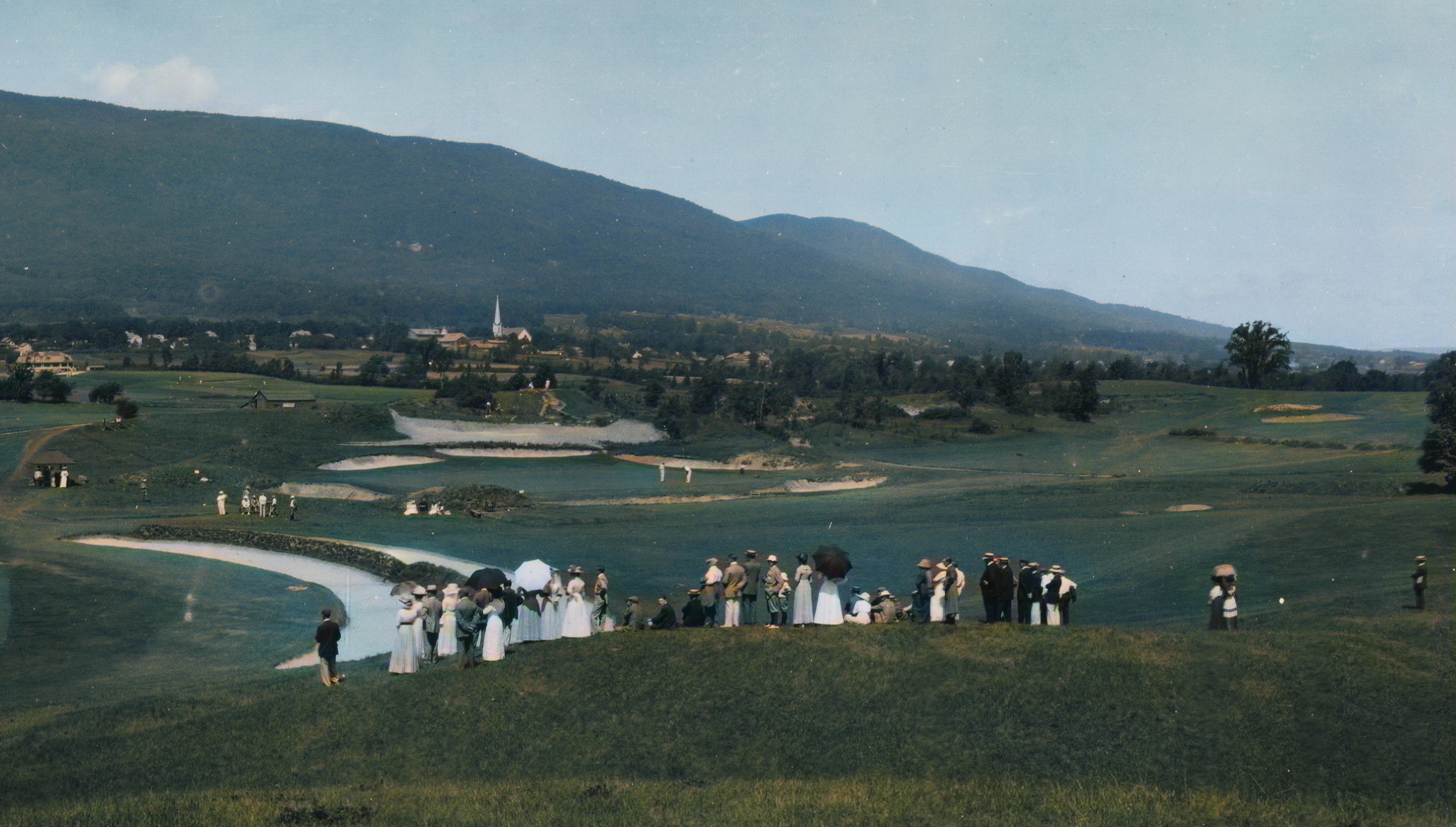
photo taken 1911 - Public Domain - Library of Congress
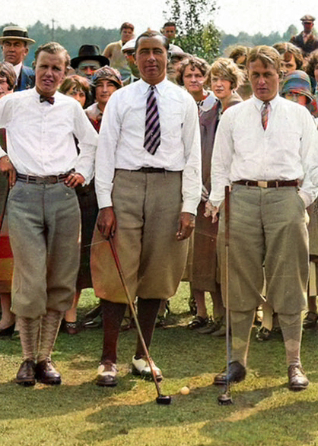
at the Highland County Club in LaGrange, Georgia 1926
Walter Charles Hagen (1892-1969) was a world recognized professional golfer, his records have only been surpassed by Jack Nicklaus and Tiger Woods. Raised in Rochester, New York, Walter started as a child to work as a caddy at the local golf course to earn money for his large family. By his mid-teens he had become an expert golfer and was giving paid lessons to the club members. At 1913 U.S. Open other professional golfers told him to step aside and that he could practice after they were through. By the end of the tournament they knew who he was as he placed fourth. The next year, 1914, he won the U.S. Open. Walter went on to win tournaments and exhibition matches around the world. He designed a matched sets of golf clubs for Wilson Sports, which was the first set of affordable clubs available to the general public. He became the first professional golfer to become a millionaire, which might have encouraged Bill Wilson's golf aspirations. He is still recognized as the "Father of Professional Golf". Walter in later life battled throat cancer for a few years, he lost the battle with it in 1967 at the age of 76. Readers of the 1939 published Big Book would have immediately recognized the name Walter Hagen.
It was fun to carom around the exclusive course which had inspired such awe in me as a lad."
1
Big Book - Bill's Story - page 4
In this sentence carom is used as noun. 2
In golf, a carom is when a ball caroms off the fairway and into the rough.

I acquired the impeccable coat of tan one sees upon the well-to-do."
1
Big Book - Bill's Story - page 4
In this sentence impeccable is used as an adjective. 2

The local banker watched me whirl fat checks in and out of his till with amused skepticism."
1
Big Book - Bill's Story - page 4
In this sentence whirl, till, and skepticism are used as nouns. Amused is used as an adjective. 2
In the late summer of 1929 Bill became uneasy with the swinging movements in stock. At the time he was holding close to the majority shares in Penick & Ford. Deciding it was time to sell some, he and Lois returned to New York. Consulting with a few men, he considered experts, they convinced him there was still time before the market would peak. He changed his decision and held his P&F shares.


"The ticker still clattered. I was staring at an inch of the tape which bore the inscription XYZ-32."
1
Big Book - Bill's Story - page 4
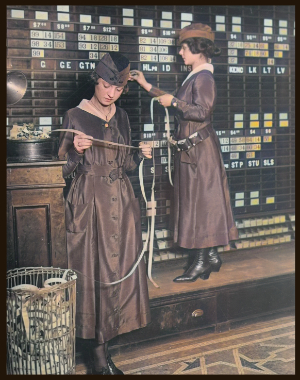
The Waldorf-Astoria Hotel is employing girls to operate tickers and stock exchange boards.
The Waldorf is the first to employ girls in its various departments,
in order to release men for war work.
from NARA - photo taken Sep 18, 1947
This passage has two items to be defined. The ticker and XYZ-32
Thomas Edison, in 1870, invented the Stock Ticker. This machine, attached to telegraph lines, printed the current price of trading stocks. The "ticker" printed a stock symbol with its then current price on a paper ribbon. The paper ribbon was called "ticker tape". Before Edison's invention to receive information transmitted over the telegraph lines a telegraph operator would listen to a series of clicks, sent in Morris Code, and then wrote each letter as it was sent. Commonly there was a 15 to 20 minute delay. This was a tedious process which required a trained operator and was time consuming. Edison's ticker, used a code developed by him, which allowed a single character to be sent in one second. Edison tickers, provided the current prices. The machines were typically placed in Stock exchanges, large investment firms, private investors offices, and hotel lobbies. In larger environments clerks would read the ticker and post the information on a large chalk board for all to see.
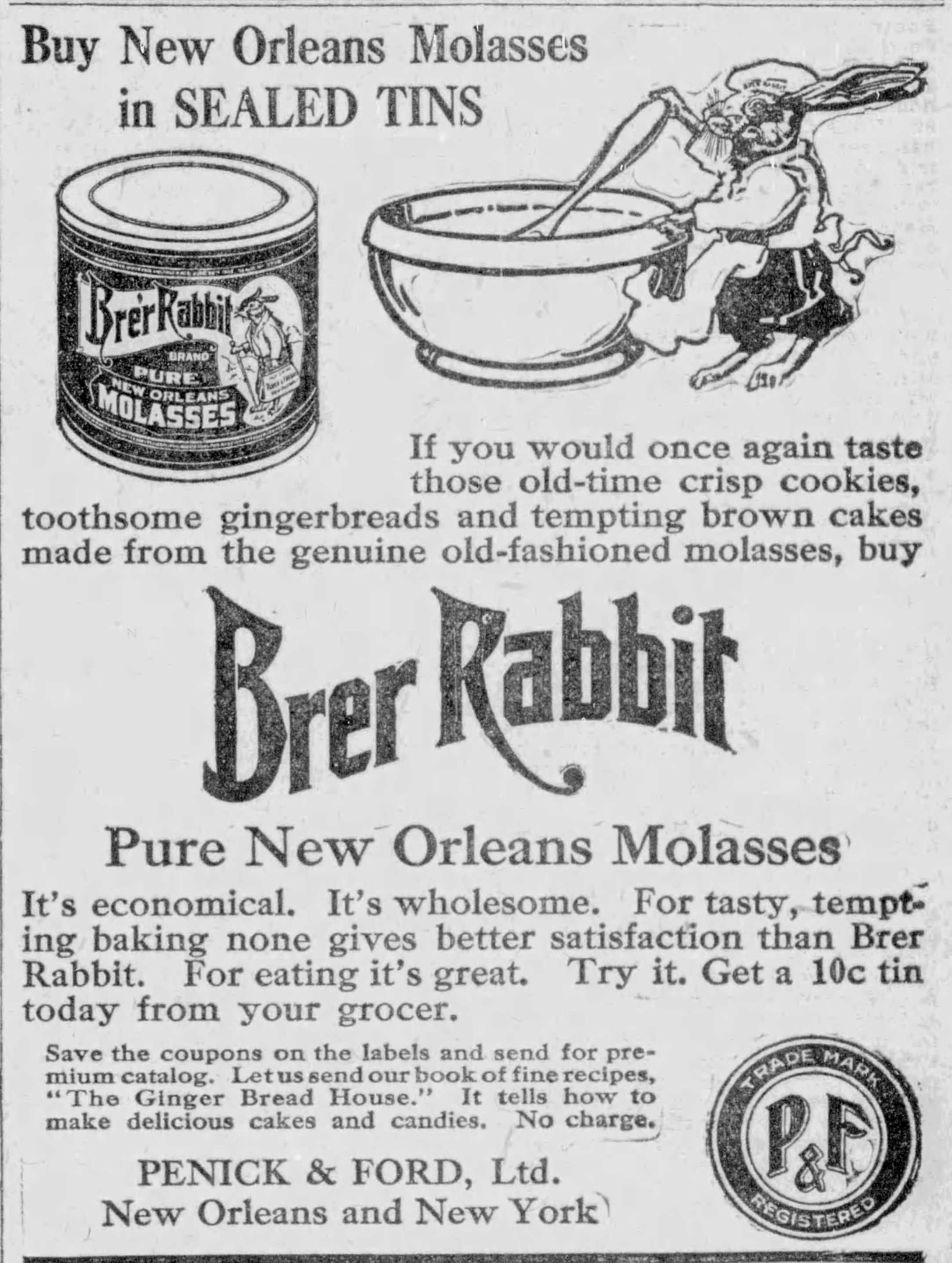
XYZ-32 - each company that traded stock was designated with a symbol, still known as a stock ticker. Bill substituted XYZ for the actual company, Penick & Ford Ltd., whose ticker symbol at the time was PKF (Bill used the actual ticker symbol in the original draft manuscript of the Big Book, but it was changed to XYZ before the first printing). In 1929, Penick & Ford produced starch for the food, textile, and paper industries, as well as Brer Rabbit Molasses, Vermont Maid Syrup, and My-T-Fine Desserts. The company is still active today under the name Penford Products Company. On October 23, 1929, the stock of P&F plummeted. The following day, known as Black Thursday, over thirteen million shares of common stock were sold in a panic. Despite the turmoil, speculators believed the worst was over, and Bill held on to his stocks.
On the night of October 29th, Bill was drinking at a Manhattan hotel bar, after the market had closed. About eight p.m., although dunk, he made his way to a nearby brokerage firm, there he found the ticker still printing. He searched the tape for PKF and found it had lost almost half its value from the morning. Even though drunk he realized that impact this meant to his investments. At the end of the 31st P&F was trading at $38. The high for the year had been $60.87. Within a few weeks an estimated 30-billion was lost in the U.S.. These events marked the end of the Roaring Twenties, replaced by the Great Depression.
The next morning Bill called an old customer in Montreal Canada. The markets in Canada had not reacted as strongly as in the US. Within a few weeks, the Montreal brokerage firm Greenshields & Company offered Bill a job. By the middle of November Bill and Lois were living in Montreal. This job lasted through the fall of 1930 when the company fired him for his many alcohol inspired escapades.
"Next morning I telephoned a friend in Montreal. He had plenty of money left and thought I had better go to Canada. By the following spring
we were living in our accustomed style. I felt like Napoleon returning from Elba. No St. Helena for me!"
1
Big Book - Bill's Story - page 4
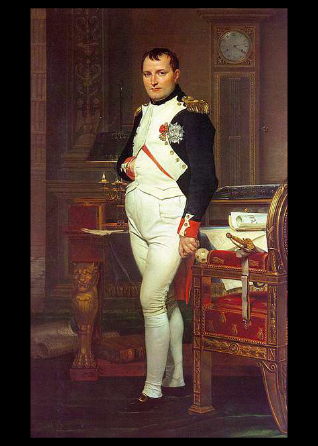
painting by Jacques-Louis David
In case you're not familiar with Napoleon's history, here's a brief summary to provide context for Bill's statement: Napoleon Bonaparte (1768-1821) was a renowned military leader who expanded the reach of France as an Emperor. Historians disagree on the exact number of his wins vs losses but the scoreboard of history approximates he won 70 battles and lost 10 during his career. These included his famous march across the French Alps in winter. After many conquests, he led a campaign with 600,000 troops into Russia. Upon reaching Moscow, they found the city abandoned and mostly destroyed. Facing the harsh Russian winter, Napoleon returned to France with fewer than 10,000 soldiers. The defeat came as a low point in his life, he attempted suicide on the return journey to Paris but the poison he carried for this use had lost most of its potency which left him with a painful failed attempt.
By March 1814, Austria, Russia, Prussia, and Great Britain all saw him as a treat to their security and took proactive action by forming a coalition to defeat him. As the allies surrounded Paris, Napoleon countered by positioning his troops for a rear attack. His plan was thwarted when Paris City Officials quickly negotiated a treaty with the foreign armies. The treaty exiled Napoleon to the French-owned island of Elba, located 6 miles off the coast of Tuscany, Italy. His stay on Elba consisted of 300 days of plotting his return to France. He put together a small fleet and set sail for France. His coup failed with his defeat at the Battle of Waterloo in June 1815 by the British Army.
At his surrender to the British Army he requested exile to America. Instead he was sent to the British-ruled island of Saint Helena. St Helena is located over 1,200 miles west of the coast of Africa. The hope he would be far enough away from France to foil any future coups. Napoleon spent his remaining years on the island. Succumbing to stomach cancer, he died in 1821. His body was exhumed by the French Government in 1840 and entombed in Paris.

In this statement, Bill Wilson, was stating he thought he was escaping the results of the U.S. market crash. Escaping to Canada, and would soon be returned to his former financial status, he would not be defeated as Napoleon had been. But his drinking caught up with him, shortly after his arrival. The company he for fired him for his drinking antics. Returning to Brooklyn, his only option was to move in with his in-laws. In reality he did end up defeated like Napoleon. 6
"I became an unwelcome hanger-on at brokerage places."
1
Big Book - Bill's Story - page 5
In this sentence hanger-on is used as a noun. 2

"Bathtub" gin, two bottles a day, and often three, got to be routine."
1
Big Book - Bill's Story - page 5
The term Bathtub gin is not included in the 1930 edition of Webster's Dictionary.
Any alcoholic drink that is made by an amateur at home or in makeshift conditions. Refers to the use of bathtubs in creating illegal
alcohol (most often gin, hence the name) during the prohibition years in the US.
from the Farlex Dictionary of Idioms
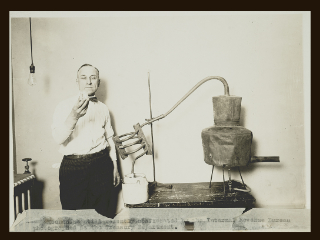
contents of a recently confiscated moonshine still.
from wikimedia.org

"prodigious"
"Then I went on a prodigious bender, and that chance vanished."
1
Big Book - Bill's Story - page 5
In this sentence prodigious is used as an adjective. 2

"My brother-in-law is a physician, and through his kindness and that of my mother I was placed in a nationally-known hospital for the mental
and physical rehabilitation of alcoholics. Under the so-called belladonna treatment my brain cleared. Hydrotherapy and mild exercise helped much.
Best of all, I met a kind doctor who explained that though certainly selfish and foolish, I had been seriously ill, bodily and mentally."
1
Big Book - Bill's Story - page 7
In this sentence prodigious is used as an adjective. 2
"My brother-in-law is a physician, and through his kindness and that of my mother I was placed in a nationally-known hospital for the mental
and physical rehabilitation of alcoholics."
1
Bill had only one sibling, a sister. Dorothy was married to Dr. Leonard Strong, a physician who practiced in Manhattan. His mother,
Dr Emily Ella Griffith-Strobell, also contributed towards his treatment at
Towns Hospital in Manhattan.

from familysearch.org
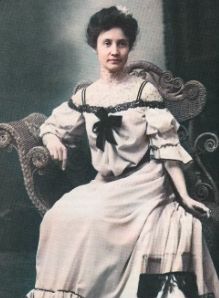
Mother of Bill Wilson
photo from findagrave.com
Under the so-called belladonna treatment my brain cleared.
1
The Belladonna Treatment was developed by Charles Towns and was the primary therapy used at his hospital in Manhattan. This treatment involved a regimen
of herbs, mercury, and castor oil, administered hourly for several days to detoxify active alcoholics and drug addicts. One of the key components of
the treatment was the plant Belladonna, commonly known as Deadly Nightshade. For more details about the Belladonna Treatment used at Towns Hospital,
please refer to the history section of this website. -
Towns Hospital


photo public domain from wikimedia.org
"Hydrotherapy and mild exercise helped much."
1

Best of all, I met a kind doctor who explained that though certainly selfish and foolish, I had been seriously ill, bodily and mentally."
2
The kind doctor is Dr. Silkworth, the author of the Big Book chapter "The Doctor's Opinion"
"For three or four months the goose hung high." 1 Big Book - Bill's Story - page 7
The term goose hung high is not included in the 1930 edition of Webster's Dictionary.
old-fashioned- Things are or will be very pleasant, desirable, or merry; everything is looking up. An allusion to the notion
that geese fly higher during pleasant weather.
4
from the Farlex Dictionary of Idioms
Canada geese fly at an altitude of 3,000 feet for migration flight. A species from Central Asia, the Bar-headed goose, migrates from India through the Himalayan range to their nesting grounds at Tibet. They have been documented as flying as high as 29,000 feet. Geese adjust their flying altitudes to fly above weather patterns. In comparison most commercial airlines cruise around 35,000 feet, helicopters between 1,000 to 5,000 feet, and hot air balloons as high as 3,000 feet.

"My weary and despairing wife was informed that it would all end with heart failure during delirium tremens, or I would develop a wet brain,
perhaps within a year."
1
Big Book - Bill's Story - page 7
Delirium Tremens (DT's) - a severe form of alcohol withdrawal

Wet Brain - the refers to Wernicke-Korsakoff Syndrome, sometimes referred to alcohol dementia. Usually caused by excess alcohol consumption results in a severe deficiency in thiamine (vitamin B1). Symptoms include delusions, vision problems, memory loss, visual hallucinations, hallucinations auditory, muscle spasms and tremors. Wet Brain has two stages. Wernicke Syndrome is often overlooked because the symptoms are mistaken as just heavy alcohol consumption. If caught early in the stage and alcohol use is terminated, it can be reversed. If excess consumption continues over time it will progress into Korsakoff Syndrome, where the symptoms become irreversible and fatal.
"insidious"
"Then came the insidious insanity of that first drink, and on Armistice Day 1934, I was off again."
1
Big Book - Bill's Story - page 8;
In this sentence insidious is used as an adjective.
2

Following are the details of the incident Bill refers to in this sentence. By Armistice Day, November 12, 1934, Bill had been dry for weeks, having been through the treatment at Towns Hospital. Armistice Day was a holiday, now known as Veterans Day, that honored WWI veterans. Bill decided to use the holiday to play a few rounds of golf on Staten Island. Having taken the ferry from Brooklyn, he boarded a bus for the final leg of his journey. The bus broke down on the way. Waiting for the replacement bus, he walked to a nearby cafe for something to eat. A fellow passenger offered to buy him a drink. Bill told the man why he could no longer drink. A few hours later, in the golf course club, a waiter walked by his table offering free scotch in celebration of Armistice Day. As Bill reached for the glass, his companion commented, "Man, you would be insane to drink that after the story you told me." Bill replied, "I am," and downed the drink. Bill did not play any golf that day; instead was found by Lois the next morning sleeping in the vestibule of the brownstone on 182 Clinton Street on her way out to work. The all too familiar cycle began again, which ended with another stay at Towns Hospital. This incident proved what Bill was to later write about in the Big Book: self-knowledge does not have the power to keep a person sober. The details of this incident are in the book Bill W. by Robert Thomsen. 6
as I sat, on still Sundays, way over there on the hillside
I could almost hear the sound of the preacher's voice as I sat, on still Sundays, way over there on the hillside; there was that proffered temperance pledge I never signed; my grandfather's good natured contempt of some church fold and their doings; his insistence that the spheres really had their music; but his denial of the preacher's right to tell him how he must listen; his fearlessness as he spoke of these things just before he died; these recollections welled up from the past.
1Big Book - Bill's Story - page 10
proffered refers to something that was offered to or presented to someone.

proffered temperance pledge
I could almost hear the sound of the preacher's voice as I sat, on still Sundays, way over there on the hillside; there was that proffered temperance pledge I never signed; my grandfather's good natured contempt of some church fold and their doings; his insistence that the spheres really had their music; but his denial of the preacher's right to tell him how he must listen; his fearlessness as he spoke of these things just before he died; these recollections welled up from the past.
1Big Book - Bill's Story - page 10
proffered refers to something that was offered to or presented to someone.
temperance - is the moderation of behavior. This Big Book sentence refers to not drinking any alcohol.

temperance pledge - In the early 19th century, temperance societies in the United States began asking people to sign pledges to abstain from alcohol. These pledges were central to the temperance movement, rooted in Protestant churches, and aimed to reduce drunkenness and its social consequences. In the early days of the movement, people might pledge to stop drinking hard liquor like whiskey and gin, but later, it became more common to pledge to abstain from all alcohol, or "teetotalism." Many Temperance organizations formed, but the Anti-Saloon League (ASL) became the most influential in writing and passing the 18th Constitutional Amendment, which outlawed alcohol. Deeply influenced by religious ideas, the ASL was founded in 1893 and, by the early 1900s, was the leading organization lobbying for the prohibition of alcohol in the United States. The League in each state county by county. By 1913, over half of the United States was dry. From 1920 to 1933, called the Prohibition era, the making, transport, selling, and consumption of alcohol was prohibited in the U.S. as stipulated by the 18th Amendment of the U.S. Constitution. The public outcry led to the passing of the Volstead Act which created the 21st Amendment to repeal the 18th Amendment. Each state must ratify a Constitutional Amendment before it becomes law. On December 5, 1933, Utah ratified the Amendment, and Prohibition ended.
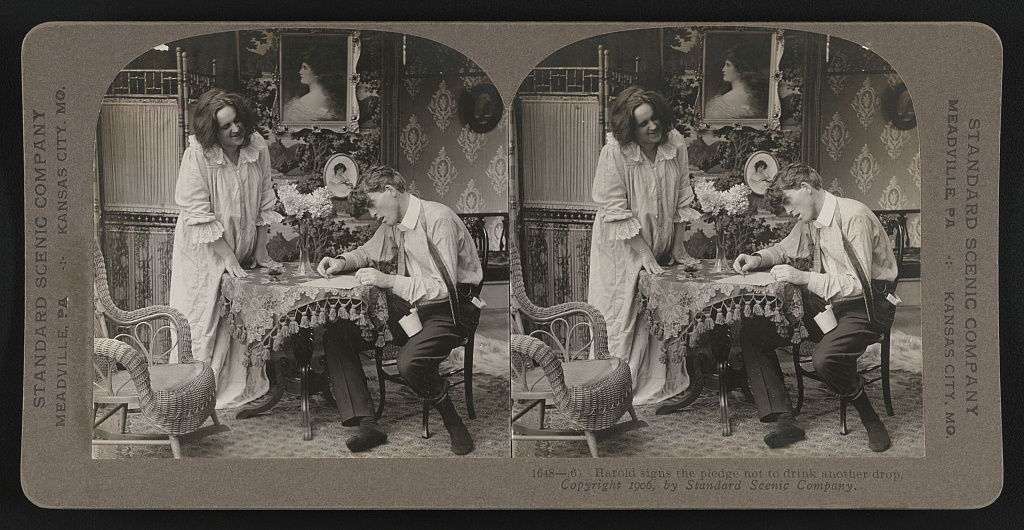
Stereograph card dated 1906
Public Domain - from Library of Congress
Music of the Spheres
Big Book - Bill's Story - page 10
"I could almost hear the sound of the preacher's voice as I sat, on still Sundays, way over there on the hillside; there was that proffered temperance pledge I never signed; my grandfather's good natured contempt of some church fold and their doings; his insistence that the spheres really had their music; but his denial of the preacher's right to tell him how he must listen; his fearlessness as he spoke of these things just before he died; these recollections welled up from the past."1
Bill Wilson in his story is recalling the thoughts he had as he listened to Ebby tell his story. His mind goes to grandfather, Gardner
Fayette Griffith, who raised him. Bill's grandfather believed the spheres really had their music"
- What is this music of the spheres?
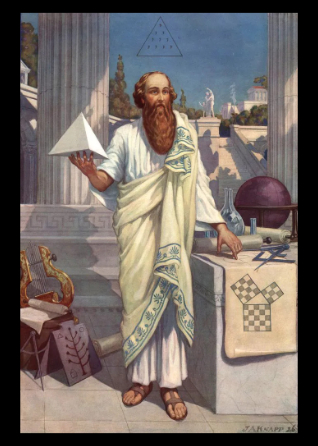
painting by John Augustus Knapp 1926
This phrase originated with the Greek mathematician and philosopher Pythagoras of Samos. The same Pythagoras who brought us the formula for calculating the length of the hypotenuse (the long side) of a right triangle. Pythagoras, theorized the pitch of a given musical note comes from the frequency of its vibration, which is still correct today. At the time the common understanding of the solar system was the earth was the center, and all other bodies rotated around it. However, he also applied his theory to the then-understood universe. He conceived that objects in the heavens moved at different speeds, and each made its own sound according to the frequency produced by its movements. Pythagoras stated "there is geometry in the humming of the strings, there is music in the spacing of the spheres". Time has proven that Pythagoras and the his following were partially on track, today the use radio telescopes to observe the radio waves (frequencies) emitted by stars, planets, galaxies and space bodies is common.
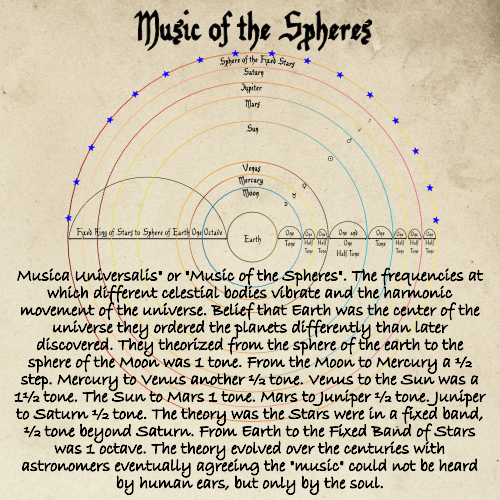
assigning tones to the solar system
concept from Thomas Stanley
"The History of Philosophy" Part 5 published 1665

National Radio Astronomy Observatory
Plains of San Agustin, New Mexico
"Scales of pride and prejudice fell from my eyes."
Big Book - Bill's Story - page 12
at the Highland County Club in LaGrange, Georgia 1926
Bill took this line from the novel Pride and Prejudice, by Jane Austen, first published in 1813. Jane Austen was first published in 1813 uaper. The original meaning of "ticker tape". Until that time to receive information transmitted over the telegraph lines a telegraph operator would listen to a series of clicks, sent in Morris Code, and had to write each letter as it was sent. Sometimes there was a 15 to 20 minute delay. This was a tedious process which required a trained operator and was time consuming. Edison's ticker, using a code developed by him, which allowed a single character to be sent in one second. Edison tickers, provided the most current prices and were typically placed in Stock exchanges, large investment firms, private investors offices, even some hotels had them in their lobbies. In larger situations a clerk would read from the ticker tape and post the information in real time on a large board for all to see.
XYZ-32 - each company that traded stock was designated with a symbol, still known as a stock ticker. In the example Bill gives in the Big Book, he substituted XYZ for the actual company, which was Penick & Ford Ltd., whose ticker symbol at the time was PKF (Bill used this ticker symbol in the original draft manuscript of the Big Book, but changed to XYZ before printing). In 1929 Penick & Ford produced starch for the food, textile, and paper industries along with Brer Rabbit Molasses, Vermont Maid Syrup, and My-T-Fine Desserts. This company is still active today, it has been sold multiple times since 1929, and now is using the name Penford Products Company. According to several biographies of Bill he did own stock in P&F. On the exchange on 29 October 1929, the P&F stock plunged. Different newspapers report different prices, the reason maybe what time of the day they pulled the figures from the ticker. Bill's number's would have reflected the price at the time the ticker record had been printed. As of 31 October 1929, the New York Stock exchange listed the high for the year at $60.87. The stock closed on the 31st at $38.
"insidious"
"One poor chap committed suicide in my home. He could not, or would not see our way of life."
1
Big Book - Bill's Story - page 16;
Here is the incident Bill is referring to in this sentence. The year is 1937. Bill had already met Dr. Bob in Akron, he was now back in Brooklyn. Bill and Lois were attending Oxford Group
weekly meetings. They were even hosting one on Tuesday night meeting at their home on Clinton Street. This group was composed of men Bill had worked with at Towns Hospital. The Tuesday
night meeting focused on alcoholics, some were even living with Bill and Lois. Some would stay with Bill and Lois, the number of men living at their
house would fluctuate as they came, left, and reappeared. In October Bill borrowed a car and he and Lois went to Baltimore for the weekend to visit
Fitz Mayo and his wife. There were a few men staying at the house on Clinton Street so Bill asked Bill C.,
one of the regulars, to be in charge of the house for the weekend. Lois decided to stayed a few extra days and Bill returned home on Monday night. When he opened the front door he
smelled natural gas. In the kitchen he found the body of Bill C., with his head inside the oven. Police said he had been dead hours before Bill discovered him.
6
"obstinacy, sensitiveness, and prejudice"
"Besides a seeming inability to accept much on faith, we often found ourselves handicapped by obstinacy, sensitiveness, and unreasoning prejudice."
1
Big Book - We Agnostics - page 47 - 48, In this sentence obstinacy, sensitiveness, and prejudice are each used as a noun.
2
Big Book Quote"
1
Big Book - Bill's Story - page 2
at the Highland County Club in LaGrange, Georgia 1926

Rev. Dr. Harry Emerson Fosdick
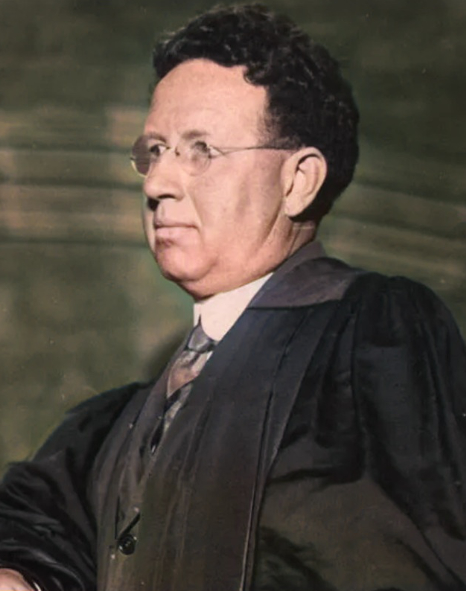
Reverend Dr. Harry Emerson Fosdick is mentioned in the Big Book "Foreword to the Second Edition" on page xvii and in the 4th edition page 572. Who is this guy and why was he important?
Dr. Harry Emerson Fosdick (1878-1969). Harry was born in Buffalo, NY. He was ordained a Northern Baptist minister in 1903 , he pastored a church at Montclair, N.J. (1904–15). During this time he also taught at Union Theological Seminary (1908–46). In 1919 Dr. Fosdick became the pastor of New York City’s First Presbyterian Church on the condition that he would still be a Baptist. In 1922 he delivered a sermon "Shall the Fundamentalists Win?". This was his challenged fundamentalists for trying to drive out of the evangelical churches men and women with liberal opinions. The sermon instead stood proudly in defense of tolerance, generosity, honesty, and liberty. The sermon was the spark that started a national controversy. John D. Rockefeller Jr. enjoyed the sermon so much he had 130,000 copies printed and mailed a copy to every Protestant minister in America. He renamed it "The New Knowledge and the Christian Faith." Later he explained his reason for distributing was "to get the view therein expressed widely read but not to stir up discord". Dr. Fosdick became the leading spokesman for modernism and the target of fundamentalist activists who labeled him a heretic. Asked years later whether he regretted his decision to preach it, Fosdick demurred. “I am profoundly sorry that the sermon has been misinterpreted. I am profoundly sorry that it has caused a disturbance; but I cannot be sorry at all that I preached that sermon. When I get to heaven I expect it to be one of the stars in my crown.”
The sermon sparked a national controversy for challenging Christian fundamentalism’s literal reading of the Bible and rejection of historical biblical analysis. His sermon did not start the conflict but certainly focused it upon himself. As a result of the controversy he was forced to resign as pastor of the First Presbyterian Church in 1925. John D. Rockefeller, Jr., as a trustee on the board of Park Avenue Baptist Church, asked Fosdick to become it's pastor. Fosdick accepted the position on the condition that the church become nondenominational, and thus Riverside Church in Manhattan was born. Within a few years the existing building was outgrown. The new building was conceived by Rockefeller, located next to Columbia University, and opened in 1930. Harry Fosdick pastored at Riverside Church until 1946. Millions listened to his weekly radio program "National Vespers" which ran from 1927 to 1946. Martin Luther King Jr. called Fosdick "the greatest preacher of this century". King in his speeches often drew on themes and passages from the sermons of Fosdick. Harry died at the age of 91 from a heart condition.
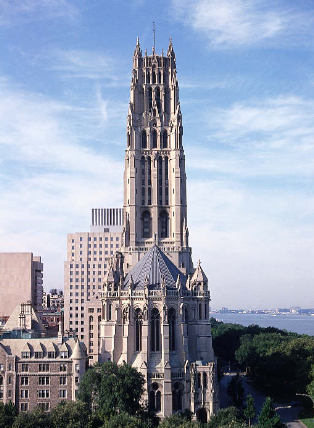
- His books were read by Dr Bob and are found in Bob's private library.
- He became a friend to Bill Wilson.
- Rev Fosdick, pastor to J.D. Rockefeller, was one of the two featured speakers at the dinner hosted on February 8th 1940 by Rockefeller at the Union Club. [side note: The Union Club of the City of New York, was founded in 1836. It still operates today as a private men's club. It is located at Park Avenue and 69th Street.]
- He is mentioned in the foreword to the Second Edition on page xvii.
- Many Americans in 1940 would have recognized Reverend Fossick's name.
- He is mentioned on page 572 of the Big Book in Appendix V - The Religious View on A.A.
- He is also mentioned on page of AA Comes of Age on page 183.
- Dr. Fosdick wrote in his own autobiography titled "The Living of These Days", “I have listened to many learned arguments about God, but for honest-to-goodness experiential evidence of God … give me a good meeting of A.A.”
Fosdicks' address at The Union Club Dinner hosted by J.D. Rockefeller Jr. - “Mr. Chairman and friends: I suppose we all wish that this problem of alcoholism could be solved by prevention rather than cure. There is a famous test of sanity: namely, turn a faucet into a basin and ask the patient to dip out the basin. If he starts to dip out the basin without turning off the faucet first, he is probably an imbecile; if he has sense enough to turn off the faucet first the chances are, he is normal. We wish we could turn this faucet of alcoholism off. I don’t know how we are going to do it. We tried prohibition and that did not work. But I sincerely hope that this movement which starts on the curative side of dipping out those who have fallen into alcoholism may indicate a coming psychological revolution in this country against the mad extremes to which the use of alcohol is going, and that it may lead to preventive measures. In the meantime, however, we face the need of helping out those who fall under the spell of this habit. Just as we all would like to have an economic system that would abolish poverty, but still face the fact that the poor are here who must he helped, so is it with alcoholism. There is a particular reason why the appeal of the alcoholic is strong. Alcoholism does not affect simply the riffraff of humanity. It commonly afflicts some of the most charming, lovable and valuable people in the community. Everyone here, going back over the recollection of his friends, would at once validate that statement. The alcoholics that I have known have commonly been among the most charming, convivial, and congenial people. I well remember one of the handsomest men in college in my day, one of the best musicians, one of the best students. I never will forget in his senior year his meeting me one night on the campus - we had all been worried about his condition - and throwing his arms around me, saying, “Fosdick, it has got me, it has got me.” Well, it had. He was fired from college and a year or two later forged his father’s check and shot himself. Every one of us can remember these lovable, able, efficient, charming personalities that have fallen under the curse of alcohol. There is a particular appeal in any movement that promises to rescue men like these from their thralldom. Dr. Foster Kennedy, speaking from the standpoint of the scientific medical man, has expressed his interest in this movement. As a minister I am interested too, because cases in this field are laid month after month upon the minister’s doorsill. Just as Dr. Kennedy would say that a certain measure of success attends the efforts of the neurologist, so a minister would say that a certain amount of success attends his efforts. We all of us have happy memories of cases that have come to us, in one degree or another the victims of alcohol, and we have helped to get them on their feet, have brushed them off and sent them back high, wide and handsome. But the percentage of failures is appalling, and there comes a place where the degree of obsession is so terrific, as Mr. Wilson has pointed out, that a minister is baffled, and turns frantically wherever he can hope to find some help. There are two or three special reasons why this movement, which has been presented to you tonight, interests me and seems to me to have unusual promise in it. In the first place, this idea of setting an ex-alcoholic to catch an alcoholic is good. You remember the title of Charles Reade's novel, “Put Yourself in His Place.” You cannot really help a man in tragedy unless you can put yourself in his place. What good am I, then, in dealing with an alcoholic? I cannot stand liquor; I go to sleep on a glass of wine; I could not be a drunkard if I wanted to; I don’t like the taste of alcohol, hate the effect of it, cannot stand it. Now a fellow who is in the grip of alcoholism comes to me. I cannot put myself in his place. There are certain areas where I can help people. I can help people in Dr. Foster Kennedy’s realm, for the simple reason that I have been through a complete nervous breakdown, and with all due respect to the neurologists, once in a while I think I can supplement what they do. For while a neurologist knows more in a minute about a nervous breakdown than I do in a week, there are a lot of them who have never been through a nervous breakdown themselves. So, I often help in cases that come to me in various stages of nervous decomposition. The other day I said to a young neurotic, who started to tell me how he felt, “Wait a minute, you don’t need to tell me how you feel. Let me tell you how you feel.” I gave him a blueprint of all the feelings and thoughts that were going on inside of him, and when I was through, he said, “My God, how did you know that?” I could put myself in his place, but I cannot do it with an alcoholic. Now comes a movement, an astonishingly apt and pertinent movement, where men who have been in the thick of this thing, who have faced the hopelessness of the situation, who have felt that they never could get well, have found resources of strength and have come out and there is not a thing about alcoholism they do not know. I think that psychologically speaking there is a point of advantage in the approach that is being made in this movement that cannot be duplicated. I suspect that if it is wisely handled-and it seems to be in wise and prudent hands – there are doors of opportunity ahead of this project that may surpass our capacities to imagine. There is another element in this movement that interests me - its tolerance, its breadth, its inclusiveness, its catholicity. If this were a movement that thought it had a panacea, that had a neat exclusive formula, that was dogmatic about it, I would have my fingers crossed. But here is a movement that puts its arm around medicine on one side and religion on the other and says, we will take in everything that can help us, that crosses all boundaries of sect and creed and is ready to use any resources of assistance that are available. These men are open-minded, not supposing that they have a neat formula that settles everything. I think the spirit in which this work is carried on is wise and promising. Still another element in this movement greatly concerns me. Just as Dr. Kennedy would be interested in the medical aspects of it, I am interested in the religious aspects of it. It is a movement which treats on equal terms Jew, Roman Catholic, Protestant and even agnostic. Mr. Wilson, I am right, am I not, you told me you had always been an agnostic?”
Mr. Wilson: “Very much so.”
Mr. Fosdick: “He did not say that when he spoke, but I think it will help you to get this background of Mr. Wilson’s irreligion. He was not a religious man. He came into this experience out of fairly pugnacious agnosticism. Confined in an asylum, laid up by alcoholism, he reached the end of his rope, hopeless, no way out at all, until one day he said, If there be a God I will throw myself back on any God there is. Here is a discovery, it seems to me, on the part of people who come from Judaism, Roman Catholicism, Protestantism and agnosticism, of one of the most elemental experiences in religion - the inner tapping of resources of power beyond ourselves. A whipped man morally feels like a pool that is exhausted. It is as though all the strength he had were a pool on the surface of his life, and the sun has been too hot and it has dried up, there is nothing more for him to rely on. Then he discovers this elemental religious experience and he does not feel like a pool any more but like a river; there is a lot of water coming down from upstream if he will keep the channels open; the sources of power are no longer so much in him as through him. Ruskin used that idea, you will remember, in describing great artists, some of whom he said knew they were doing the best work that had ever been done, but they were very humble about it because, said Ruskin, they all knew that the power was not IN them but THROUGH them. To use the figure of Professor Wieman of the University of Chicago, it is as though a man could inwardly throw a switch and complete a circuit and lo, the waiting power comes in. A lot of these men, as I have touched this group, have gotten at God that way, not theoretically, not as a matter of speculation but rather in a moment of despair they found out how to throw a switch and complete a circuit, and lo, something came into them. They call it God. It is God. I remember as a boy I was brought up near Niagara Falls. I was there when the turbines were put in at the power plant, and I shall never forget the first time I saw that man walking quietly around in the room in which their controls were located. He was not creating power, he was releasing it. We never create power. Nobody ever created any of his own physical power. You do not blow on your hands and create power. All power comes from assimilation, we take it in. These men have gotten somehow at this inner core of religion, deeper than Judaism, deeper than Roman Catholicism, deeper than Protestantism, underlying them all, experienced in them all, so that men from all these different fields meet on equal terms in this group, and the agnostics come in too, who never have had any theories of God, but now have found His power. Throw a switch, complete the circuit! Stop being a pool, become a river! Do not create power! You cannot! Release power! I call that an essential experience of religion, and I am interested to see a group that has run on it in this utterly unconventional, unorthodox way and is so inclusive, taking in all sorts and conditions of men from all kinds of religious and irreligious backgrounds, finding here the one spiritual dynamic that can lift a man out of the mire when nothing else can. Last of all, I admire the quietness, the anonymity with which this movement is carried on. Very small overhead financially, no big organization, nobody making anything out of it, no high-salaried staff, people for the love of it sharing with others the experience that has meant life to them - that is good work. No one is a prophet, but I suspect that there is a long road ahead of this movement.”
Book Review of the Big Book by Rev. Fosdick - Rev. Fosdick was the first clergyman to review the Big Book.
This extraordinary book deserves the careful attention of anyone interested in the problem of alcoholism. Whether as victims, friends
of victims, physicians, clergymen, psychiatrists or social workers there are many such, and this book will give them, as no other
treatise known to this reviewer will, an inside view of the problem which the alcoholic faces. Gothic cathedral windows are not the
sole things which can be truly seen only from within. Alcoholism is another. All outside views are clouded and unsure. Only one who has
been a alcoholic and has escaped the thralldom can interpret the experience.
This book represents the pooled experience of 100 men and women who have been victims of alcoholism-and who have won their freedom and recovered their sanity and self-control. their stories are detailed and circumstantial, packed with human interest. In America today the disease of alcoholism is increasing. Liquor has been an easy escape from depression. As an English officer in India, reproved for his excessive drinking, lifted his glass and said, "This is the swiftest road out of India," so many Americans have been using hard liquor as a means of flight from their troubles until to their dismay they discover that, free to begin, they are not free to stop. One hundred men and women, in this volume, report their experience of enslavement and then of liberation.
The book is not in the least sensational. It is notable for its sanity, restraint and freedom from over-emphasis and fanaticism. The group sponsoring this book began with two or three ex-alcoholics, who discovered one another through kindred experience. From this a movement started; ex-alcoholics working for alcoholics, without fanfare or advertisement, and the movement has spread from one city to another.
The core of their whole procedure is religious. They are convinced that for the helpless alcoholic there is only one way out-the expulsion of his obsession by a Power Greater Than Himself. Let it be said at once that there is nothing partisan or sectarian about this religious experience. Agnostics and atheists, along with Catholics, Jews and Protestants, tell their story of discovering the Power Greater Than themselves. 'Who are you to say that there is no God,' one atheist in the group heard a voice say when, hospitalized for alcoholism, he faced the utter hopelessness of his condition. Nowhere is the tolerance and open-mindedness of the book more evident than in its treatment of this central matter on which the cure of all these men and women has depended. They are not partisans of any particular form of organized religion, although they strongly recommend that some religious fellowship be found by their participants. By religion they mean an experience which they personally know and which has saved them from their slavery, when psychiatry and medicine had failed. They agree that each man must have his own way of conceiving God, but of God Himself they are utterly sure, and their stories of victory in consequence are a notable addition to William James' 'Varieties of Religious Experience.'
"God is not a cosmic bellboy for whom we can press a button to get things." - Harry Emerson Fosdick
"Hating people is like burning down your own house to get rid of a rat". Bitterness imprisons life; love releases it." - Harry
Emerson Fosdick

|
A collection of sermons by Harry Fosdick - hosted by the archives of Riverside Church |
Liberty Magazine, Fulton Oursler, Morris Markey
"In the fall of 1939 Fulton Oursler, the editor of Liberty, printed a piece in his magazine..."
Big Book - Forward to the 2nd Edition - page xviii
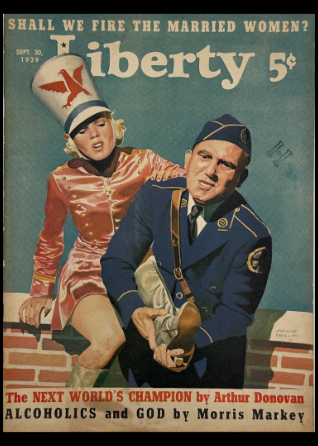
Liberty "A Weekly for Everybody" (1924-1950) This was a weekly five-cent magazine that for sometime had the 2nd largest circulation in the United States. In 1939 the editor of Liberty, Fulton Oursler, ran an article "Alcoholics and God", that was written by Morris Markey. Morris was a friend of Charles Towns, the owner of Towns Hospital where Bill Sobered up. Charles Towns told Morris of the work of Bill Wilson and the group of men he had worked with. Morris then pitched the story to Oursler, who gave him the assignment to write an article. This was the first national exposure of AA in the United States. After the article was published Liberty received 800 inquires which were sent to AA for follow-up. It was reported that Bill was not happy with the emphasis on God in the article, he worried it would cause turn away many alcoholics to Alcoholics Anonymous.
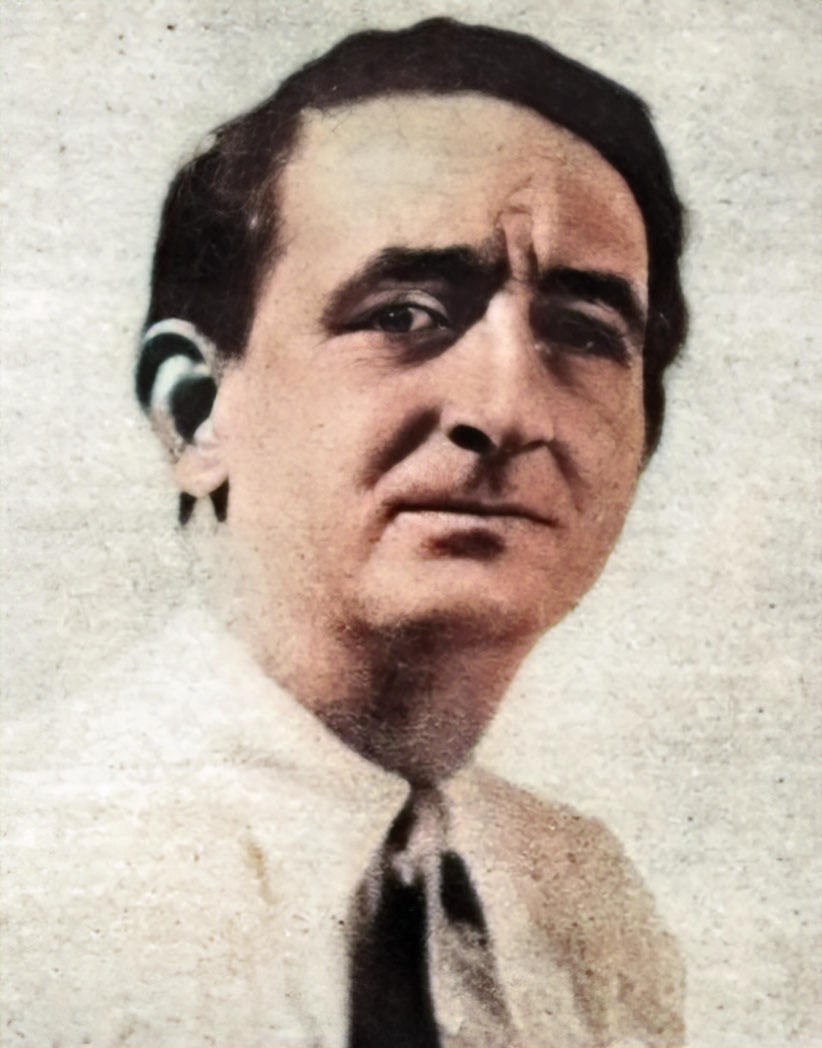
Editor, Author, Playwright, AA Trustee
Fulton Oursler (1893-1952) - Fulton was an editor, author, and playwright. Raised in Baltimore, as a teenager he became a reporter for the Baltimore American. He moved to New York City and worked for various publications. He wrote many short stories, mostly murder mysteries, under the pen name Anthony Abbot. He became a playwright with several of his plays appearing on Broadway. He served as editor of both Liberty Magazine and Readers Digest. His best known novel was "The Greatest Story Ever Told" published by Doubleday in 1949. He also wrote many crime novels and short stories under the pen name Anthony Abbot. As a result of the article Fulton became friends with Bill Wilson and then asked to serve as a trustee for the Alcoholic Foundation.
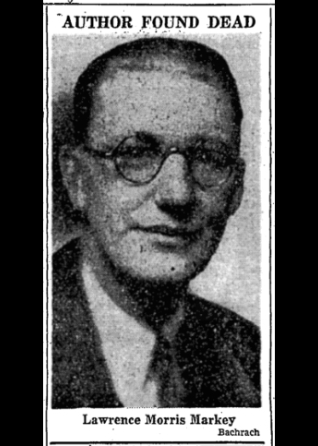
Editor, AA Trustee
photo from NY Times ~ 12 Jul 1950
Morris Markey (1899-1950) - Morris was born in Virginia. Worked for for a railroad, served in the U.S. Army in France during WWI. Morris became a newspaper reporter, working for many publications including the Atlanta Journal, Daily News, McCall's Magazine, The New Yorker Magazine, and Readers Digest. In WWII he was a war correspondent with the Navy, covering the war in the Marshall Islands, Iwo Jima, and the Philippines Sea. In July 1950 was found dead in his house in Virginia from a gunshot wound to the head. It was never been determined if it was from his own actions or by another.
John D. Rockefeller Jr.
"..., John D. Rockefeller, JR. gave a dinner for many of his friends..." Big Book - Forward to the 2nd Edition -
page xviii
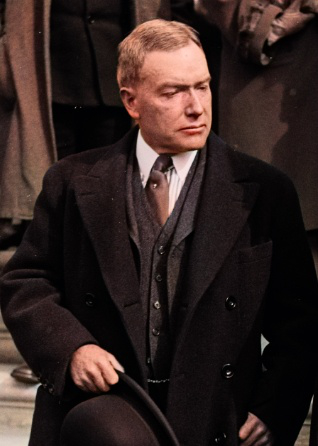
John Davison Rockefeller, Jr. (1874-1960) - John Jr. is the only son of John D. Rockefeller. John Sr. and his younger brother William founded Standard Oil, in 1870. John Sr. became the richest person in America in 1913 when his personal wealth reached over $900 million, and in 1916 became the first American billionaire. John Jr. attended Brown University, a Baptist founded school. After graduation he became a director of Standard Oil. Jr. became best known for his philanthropy, donating over $537 million over his life time. During the depression he developed Rockefeller Center in Manhattan. He funded the reconstruction of historic Colonial Williamsburg in Virginia and museums in many National Parks. Junior himself was a lifelong teetotaler but became convinced that prohibition needed to be repealed. He was instrumental in the repeal of the 18th Amendment which ended prohibition.
John Jr. invested in many companies. He became a director of U.S. Steel. His career was not without controversy. Owning the controlling interest in the Colorado Fuel and Iron Company (CF&I) he became involved in the Colorado Coal Field War in 1913. The event began when the United Mine Workers of America Union declared a strike against CF&I. CF&I brought in non-Union replacement miners and hired it's own private security force. The striking miners with their families were protesting and camping outside the company facilities in Ludlow, Colorado. The strike turned violent when the private security guards attacked the strikers. This resulted in the death of 20 people. The dead included men, women, and even some children. In response the governor activated the Colorado National Guard. This erupted into nine days of violence between the Colorado National Guard, the striking miners, the scabs (replacement miners), and the company security force. Newspapers reported the event as "The Ludlow Massacre". John Jr. was accused by many for ordering the attack and publicly attacked for his Christian faith. Jr. traveled to Ludlow, met with the families and saw the deplorable conditions in which they lived. As a result he resigned from the CF&I board and focused on family philanthropy projects.
When the article about AA appeared in Liberty Magazine, John Jr. became aware of AA. In February 1940 John Jr. he hosted a
dinner for some of his friends and invited Bill Wilson and other members of AA to tell their stories. The night of the dinner
John Jr. was ill so the dinner was hosted by his son Nelson. At the end of the dinner Nelson announced that instead of donations
they felt that AA needed to become a self-supporting movement. He did buy 400 copies of the Big Book and send them out to
friends with handwritten notes. Rockefeller also placed $5,000 in the treasury of Riverside Church (the church pastored by Harry Fosdick) to
provide temporary financial support for Dr. Bob and Bill Wilson, during the early stages of AA. The Rockefeller's also later loaned the Alcoholic
Foundation enough money to buy back the shares sold by Works Publishing to finance the writing and printing of the Big Book. This loan made AA the owner
of it's own Big Book. note - the copyright for the 1939 first edition of the Big Book expired in 1967 and the book became public domain. The copyright for the second
edition expired in 1983. The failure of AA to file paperwork to renew the copyrights was not discovered for many years. The third and fourth editions remain under
copyright world-wide to AA World Services.
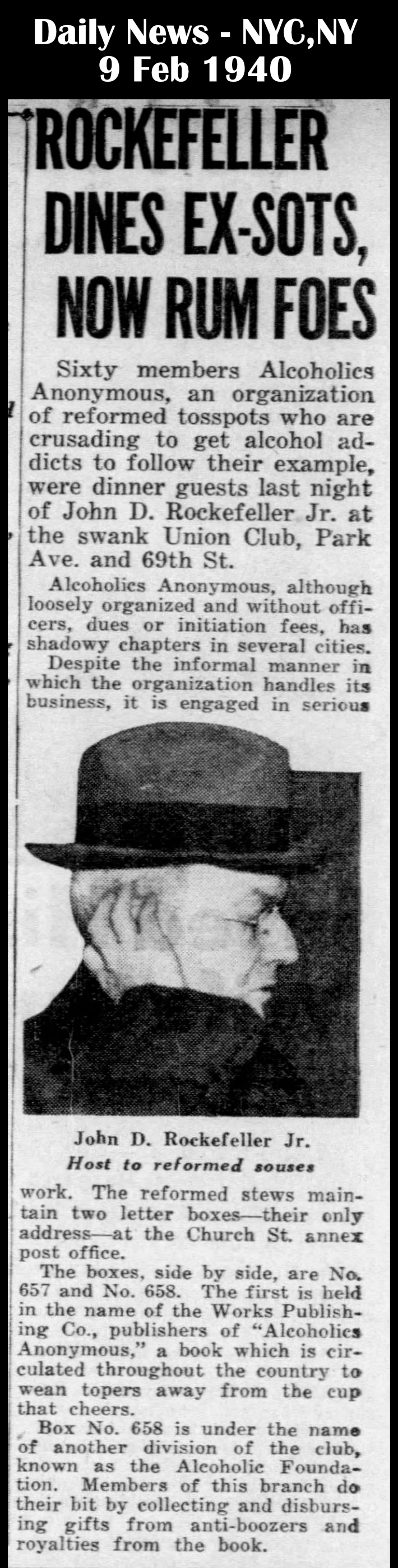
9 Feb 1940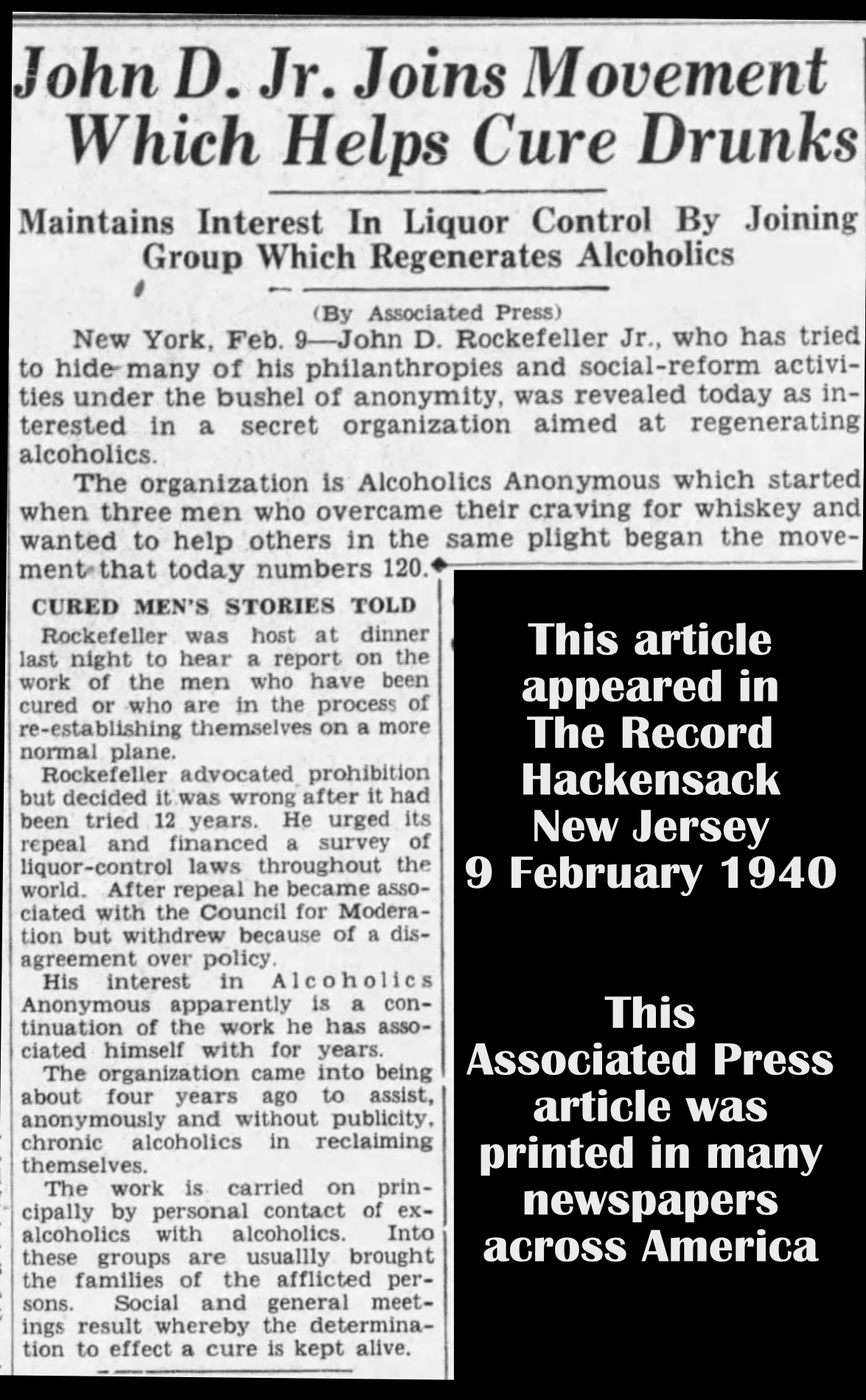
printed in newspapers across America
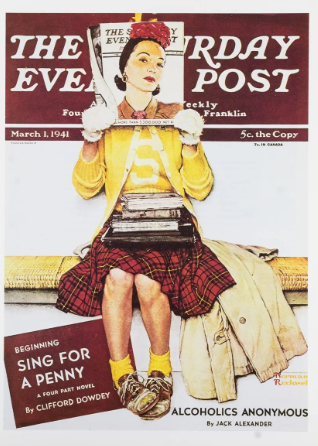
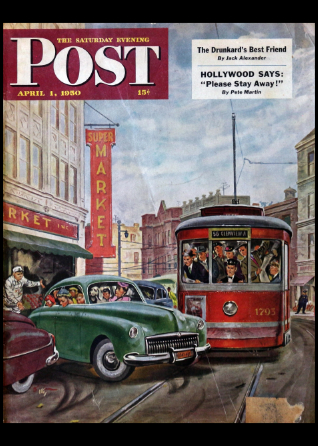
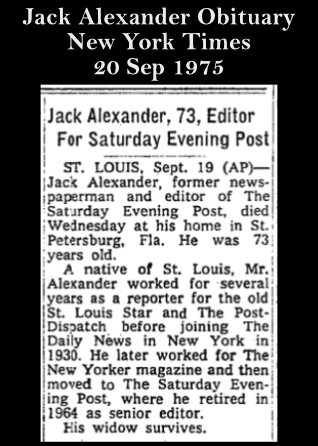
"Then Jack Alexander wrote a feature article in the Saturday Evening Post ...." Big Book - Forward to the 2nd Edition - page xviii
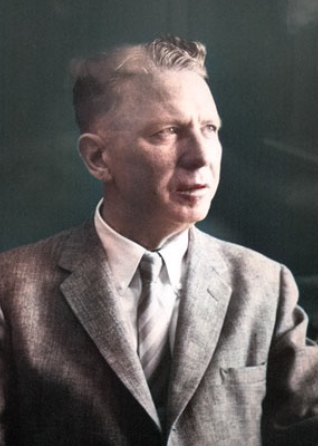
Jack Alexander (1902-1975) The March 1st 1941 edition of the Saturday Evening Post featured an article "Alcoholics Anonymous" by Jack Alexander. The magazine had a circulation of over 3 million readers at that time and this edition became the first exposure the majority of Americans learned of the existence of AA. Jack later wrote a follow-up article "The Drunkard's Best Friend" which appeared in the April 1st 1950 edition.

|
jump to the top of this page |

|
Back To The Last Section - The Doctor's Opinion pages xv - xiv |

|
On To The Next Chapter - Chapter 2 - There Is A Solution pages 17 - 29 |
Footnotes for page
- 1Quotes from the Big Book on listed on this page are from the public domain version, in the United States, of the 2nd edition of the book Alcoholics Anonymous. Accessible at 12step.org
- 2Sentence diagramming, to determine the word usage within the sentence, was performed by CoreNLP at corenlp.run.
- 3Definitions used are from the Webster's New International Dictionary of the English Language 1930 Edition
- 4An idiom is a phrase or expression that has a symbolic meaning different from the literal interpretation of the words. Over time, the meaning of an idiom can change or become outdated as its original historical context is forgotten by newer generations. For example, the idiom "grasping at straws" describes a desperate attempt to achieve something with very little chance of success. Originally, "straws" referred to the reeds that grow at the edges of a body of water—something a drowning person might try to grab onto in an effort to save themselves. For idioms not listed in the 1930 Webster's Dictionary the Farlex Dictionary of Idioms was used.
- 5WWI history of the 66th Battalion Battery C from Coast Artillery Organizational History, 1917-1950 Part I, Coast Artillery Regiments 1-196 by William C. Gaines
- 6Historical events taken from the books "Bill W." by Robert Thomsen (1975), and "Bill W." by Francis Hartigan (2000).
- 7 phrase meaning from Google AI search.

Reference for the 8 Parts of Speech Reference
There are eight parts of speech in the English language. The part of speech indicates how the word functions in meaning as well as grammatically within the sentence. An individual word can function as more than one part of speech when used in different circumstances. Understanding parts of speech is essential for determining the correct definition of a word when using the dictionary.
- Noun - the name of a person, place, thing, or idea. a thing (book), a person (Noah Webster), an animal (cat), a place (Omaha), a quality (softness), an idea (justice), or an action (yodeling)
- Pronoun - used in place of a noun - any of a small set of words (such as I, she, he, you, it, we, or they) in a language that are used as substitutes for nouns or noun phrases and whose referents are named or understood in the context.
- Verb - expresses action or being - jump... is... write... become - The verb in a sentence expresses action or being.
- Adjective - modifies or describes a noun or pronoun. An adjective is a word used to modify or describe a noun or a pronoun. It usually answers the question of which one, what kind, or how many. pretty... old... blue... smart (Articles [a, an, the] are usually classified as adjectives.)
- Adverb - modifies or describes a verb, an adjective, or another adverb. gently... extremely... carefully... well - An adverb describes or modifies a verb, an adjective, or another adverb, but never a noun. It usually answers the questions of when, where, how, why, under what conditions, or to what degree. Adverbs often end in -ly.
- Preposition placed before a noun or pronoun to form a phrase modifying another word in the sentence. by... with.... about... until - (by the tree, with our friends, about the book, until tomorrow) A preposition is a word placed before a noun or pronoun to form a phrase modifying another word in the sentence. Therefore a preposition is always part of a prepositional phrase. The prepositional phrase almost always functions as an adjective or as an adverb.
- Conjunction - joins words, phrases, or clauses. and... but... or... while... because - A conjunction joins words, phrases, or clauses, and indicates the relationship between the elements joined. Coordinating conjunctions connect grammatically equal elements: and, but, or, nor, for, so, yet.
- Interjection - used to express emotion. Oh!... Wow!... Oops! - An interjection is a word used to express emotion. It is often followed by an exclamation point.