
The Swedenborgian Church
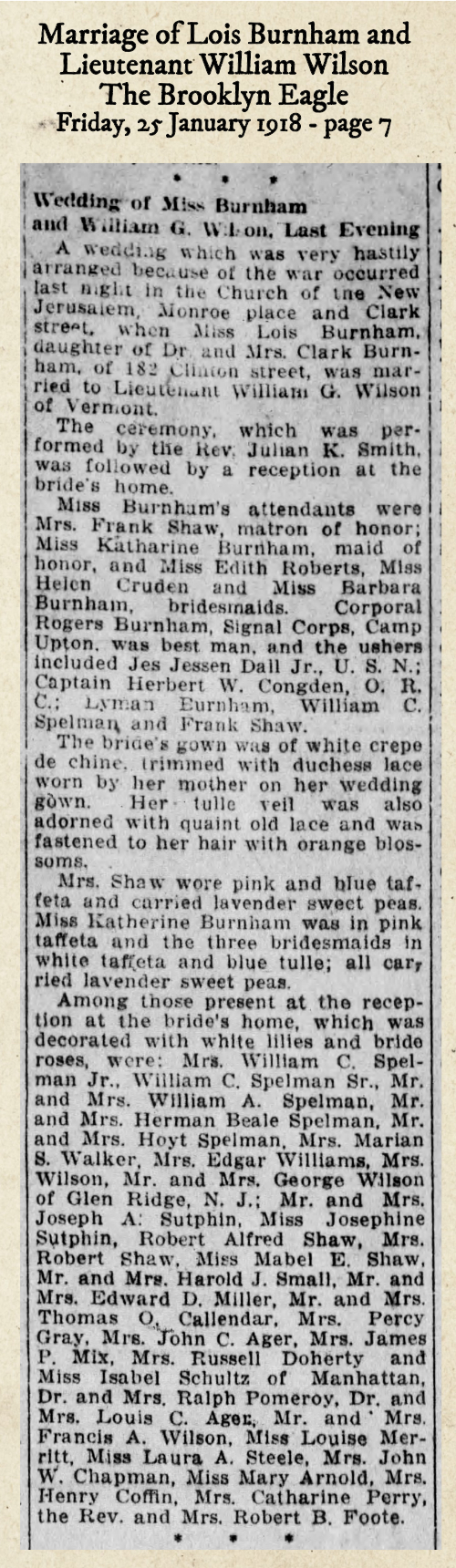
Lois Wilson grew up in the Swedenborgian Church in Brooklyn, called the Swedenborgian Church of the New Jerusalem. Her paternal grandfather, Nathan Clark Burnham, practiced law and medicine, and was a minister of a Swedenborgian Church in Lancaster, Pennsylvania. He was a well-known figure in the movement, not only ministering but also publishing many articles about the Swedenborgian movement. Lois was just 6-months old when her grandfather died. Growing up in Brooklyn her family were members of the Swedenborgian Church in Brooklyn. She and Bill were married in the church.
History of the Brooklyn Swedenborgian Congregation
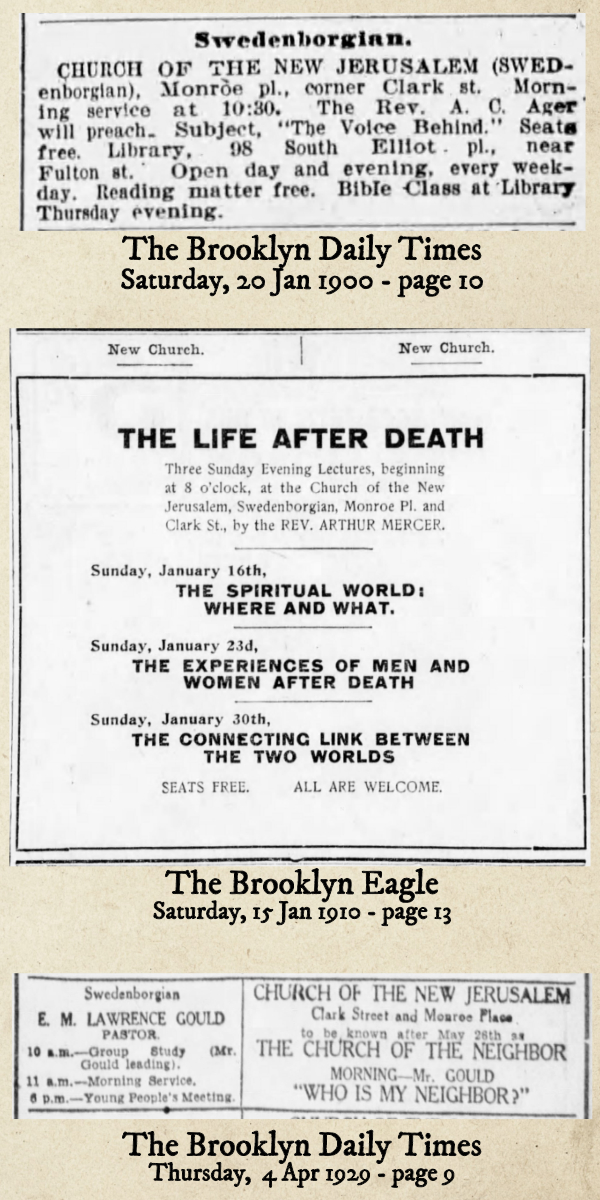
The Brooklyn church began meeting in 1859 under the name "Swedenborgian Church of the New Jerusalem." In 1868, the congregation moved to the old Universalist Church at Clark Street and Monroe Place in Brooklyn Heights. The pastor changed the name to "The Church of the Neighbor" in 1929. By the 1950s, only about a dozen members remained. Sunday services stopped in 1954 and were replaced by a Thursday evening service led by the Manhattan Swedenborgian Church’s pastor. The final service took place in early 1959, marking the church’s 100th anniversary. Afterward, the building was abandoned, vandalized, and set on fire several times. It was demolished in 1961 and replaced with an apartment building.
Today the number of active Swedenborgian congregations world-wide are few in number.
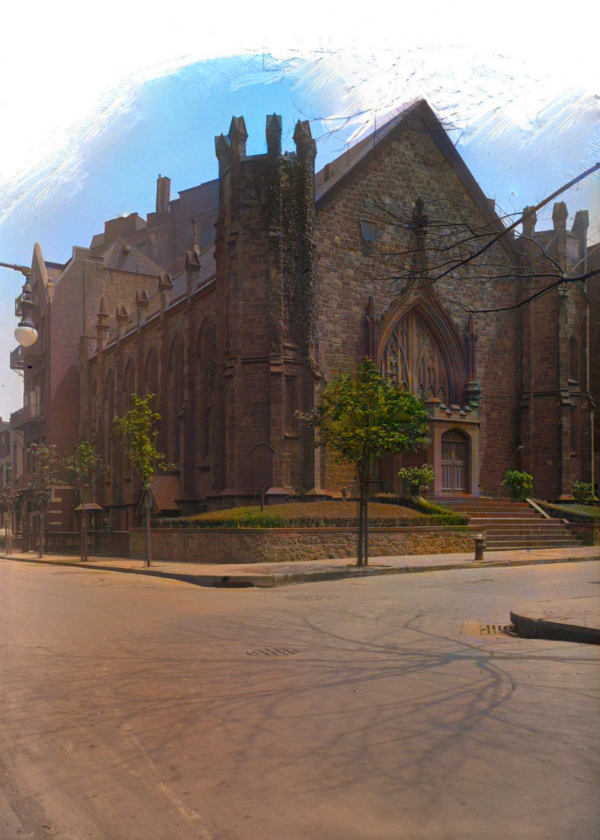
SE corner of Clark Street and Monroe Place, Brooklyn, NY
Photographer was Eugene L. Armbruster, 1865-1943 - Photo taken in 1922
New York Historical Society & the Library of Congress
Origins of the Swedenborgian Church
The church was based on the writings of Emanuel Swedenborg. The movement called Swedenborgian, are organized under the following groups:
- General Conference of the New Church (Great Britain)
- Swedenborgian Church of North America a.k.a. General Convention
- The New Church
- The Adelaide Society of the New Church (Adelaide, Australia)
- General Church of the New Jerusalem a.k.a. General Church.
"The New Church"
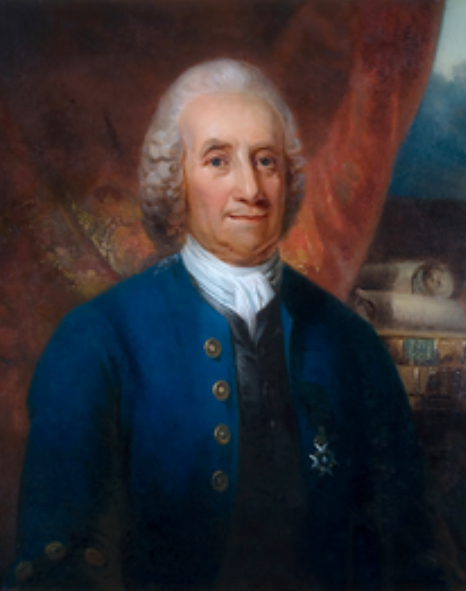
portrait by Carl Frederik von Breda
Emanuel Swedenborg (1688–1772)
Emanuel Swedenborg was a Swedish scientist and philosopher, and in his later life, a mystic. Emanuel was raised a Lutheran. His father, a university professor of theology, was involved with the Lutheran Pietism movement. The Lutheran Pietism movement emphasized direct communion with God. The followers met in small groups to read the Bible, pray together, and encourage one another to live holy lives. Some notable figures who practiced Lutheran Pietism include John Wesley, founder of the Methodist movement, and Alexander Mack, founder of an early branch of the Anabaptist Brethren. During his father's lifetime, these beliefs were considered radical and had a major impact on Emanuel.
As a teenager, he attended university, traveled Europe, and lived in London for four years. He studied physics, mechanics, and philosophy. He later requested the King of Sweden fund a project to build an observatory; the request was denied, but instead appointed as the assessor-extraordinary on the Swedish Board of Mines in Stockholm. In his 30s, he published a scientific periodical that covered mechanical and mathematical inventions and discoveries. In one, he described a flying machine he envisioned. His inventions include a submarine, an automatic weapon, musical instruments, a system of sluices to transport boats across land bridges, and multiple types of water pumps. His water pumps were used by the Swedish Board of Mines. In the 1730s, he studied anatomy and physiology. This is the first known mention of neurons in the brain, a full century before the discovery of the nerve cell. He presented concepts of the brain's regions, the nervous system, and the association of the frontal brain with intellect. During this period, he sought to find a connection between matter and spirit. He published works on the smelting of iron and copper, which provided him with an international reputation. In the late 1940s, he took a leave of absence from the Board of Mines to travel. He intended to research and publish on the relationship between the human soul and the human body.
While traveling in the Netherlands, he began having dreams that he recorded in a journal. These were later published. At the age of 57, while eating in a private room in a London tavern, he saw a man sitting in the room with him. The man told him not to eat too much. Later that night, the same man appeared in his dreams, claiming to be God and to have appointed Swedenborg to reveal the spiritual meaning of the Bible. That night, he believed the spiritual world was open to him. For the next ten years, he wrote and published these revelations anonymously in eight volumes. He continued publishing on these subjects through 1770. Back in London, preparing to publish his last work, he had a stroke and was confined to bed. Swedenborg wrote a letter to John Wesley relaying the spirits had given him a message that Wesley needed to hear. Wesley had been reading Swedenborg's works and replied that he would arrive in 6 months. Swedenborg replied to Wesley that the meeting would not occur as Swedenborg was going to die on March 29, 1772. The meeting never did occur as Swedenborg predicted the exact day of his death.
In his writings, he described a "new church" based on his theology, but he never tried to establish it. He described this universal church as based on love and charity, rather than multiple churches named after their founders and grounded in a belief or a doctrine. Fifteen years after his death, followers of his writings established "The New Church". The New Church is also known as Swedenborgianism. Some well-known personalities, influenced by the writings of Swedenborg, include William Blake, Charles Bonney, Calvin Coolidge, Ralph Waldo Emerson, Robert Frost, William James, Dr. Carl Gustav Jung, Helen Keller, Franklin D. Roosevelt, and John Chapman (a.k.a. Johnny Appleseed), who was a Swedenborgian missionary.
“Love comes into being through useful service to others.” - Emanuel Swedenborg
“Love consists in desiring to give what is our own to another and feeling his delight as our own.” - Emanuel Swedenborg
Influence of The New Church Swedenborgian Movement
The New Church teachings influenced both the American Transcendentalism and the New Thought movements.
The Transcendentalism Movement originated in New England during the 1820s. Adherents asserted that individuals could discover truth through intuition rather than relying solely on logic, experience, or religious tradition. They maintained that the individual soul was intrinsically connected to both nature and God. Prominent figures in the movement included Ralph Waldo Emerson, Henry David Thoreau, George Ripley, Margaret Fuller, Walt Whitman, Amos Bronson Alcott, Elizabeth Palmer Peabody, and Theodore Parker. The movement gained momentum at Harvard University following the rise of Unitarianism. Notably, Ralph Waldo Emerson was the son of a Unitarian minister.
The New Thought Movement, is also known as Higher Thought. The movement is based on the teachings of Phineas Quimby. This movement has
influenced the modern-day Unity Church and the Church of Divine Science. Emmet Fox,
a popular speaker and author among early AA members in New York, was the pastor of The First Church of Divine Science in Manhattan. His church was
affiliated with the Divine Science denomination of the New Thought movement. Ernest Holmes, founder of Religious Science, was also influenced by
the New Thought movement.

|
The Swedenborgian Church of North America |

|
back to the Introduction page |