
These pages are a journal of a record made while reading through the Big Book, Chapter 1 - Bill's Story. Wandering through his story, looking up words not commonly used today, and learning about the historical events that surrounded Bill’s story was the goal. Language and the importance of historical events change over time. A popular dictionary, widely available at the time the book was written, was consulted to understand the meanings the words had at the time. We don’t know if Bill consulted a dictionary. In his personal library at Stepping Stones, there are several English dictionaries, but all were printed after 1939, so he would not have had access to them when writing this chapter.
You are encouraged to wander through the Big Book, take all the back roads you can find, you will discover some not listed in this journal; it will not be wasted time.
A Historical Background for Bill's Story
During the summer of 1914, two important events occurred: Bill Wilson met Lois Burnham, and the Archduke Franz Ferdinand of Austria was assassinated. Lois, from Brooklyn, was spending the summer at her family's summer home in Manchester, Vermont. Bill was born and raised in East Dorset, Vermont, and lived nearby with his maternal grandparents. At summer’s end, Bill left to attend a small military college in Northfield, Vermont, and Lois left to begin a new teaching job in New Jersey. But the relationship outlived the summer, growing with each new visit and letter. The assassination of the Archduke was the spark that ignited World War I.
As war events unfolded in Europe, various countries entered the war. Even though Germany implemented a maritime blockade of Britain, allowing only one U.S. ship safe passage to England each week, the United States hesitated to be involved. U.S. public opinion spun when a German telegram en route to Mexico was intercepted, decoded, and published in newspapers. Germany suggested that Texas, Arizona, and New Mexico would be given to Mexico if Mexico agreed to ally with Germany. Fear spread across the country, prompting a special session of Congress. On April 6, 1917, the U.S. declared war on Germany and joined with the Allies in fighting German aggression.
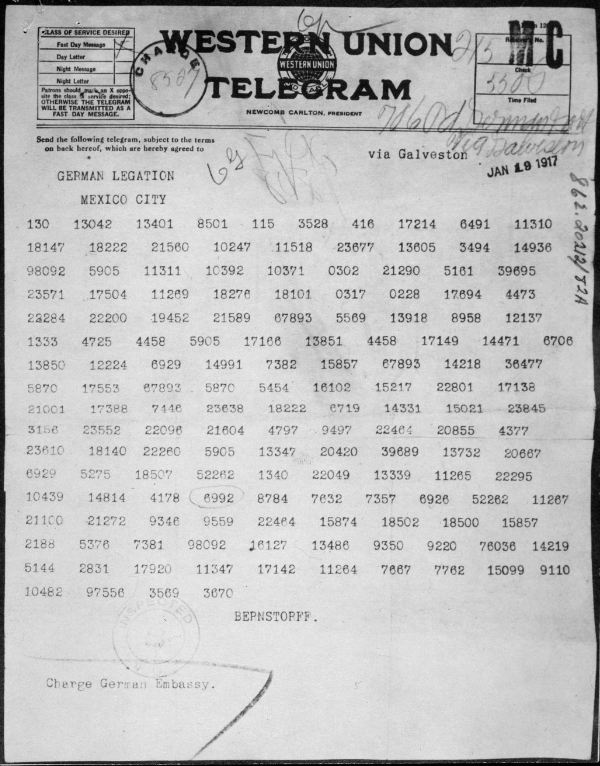
which sparked the U.S. to declare war on Germany
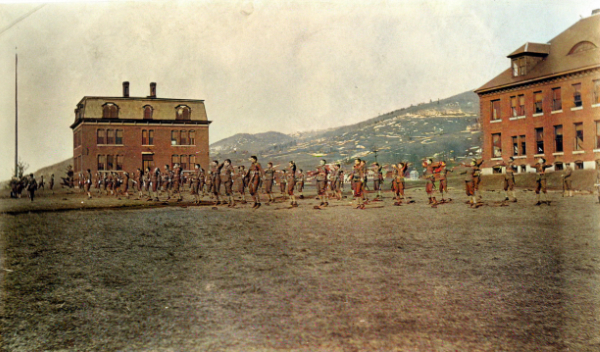
In response to the national crisis, Norwich University canceled all academic classes and directed cadets to focus entirely on military drills. Within a few weeks, many cadets, including Bill, volunteered to join the army. The Norwich cadets were organized into a Reserve Officers' Training Corps (R.O.T.C.) unit and immediately sent to Plattsburgh, New York, for training. After completing the first training phase, Bill joined the Coast Artillery and underwent eight additional weeks of field artillery training in Fort Monroe, Virginia. Upon graduation, the 22-year-old Bill was appointed a Second Lieutenant. His first duty station was Fort Rodman, Massachusetts. While there, an affluent local family hosted weekend events for soldiers at their estate in New Bedford. Bill later recalled these gatherings as the place he discovered Bronx Cocktails, a combination of gin, vermouth, and orange bitters, alleviated his chronic social anxieties.
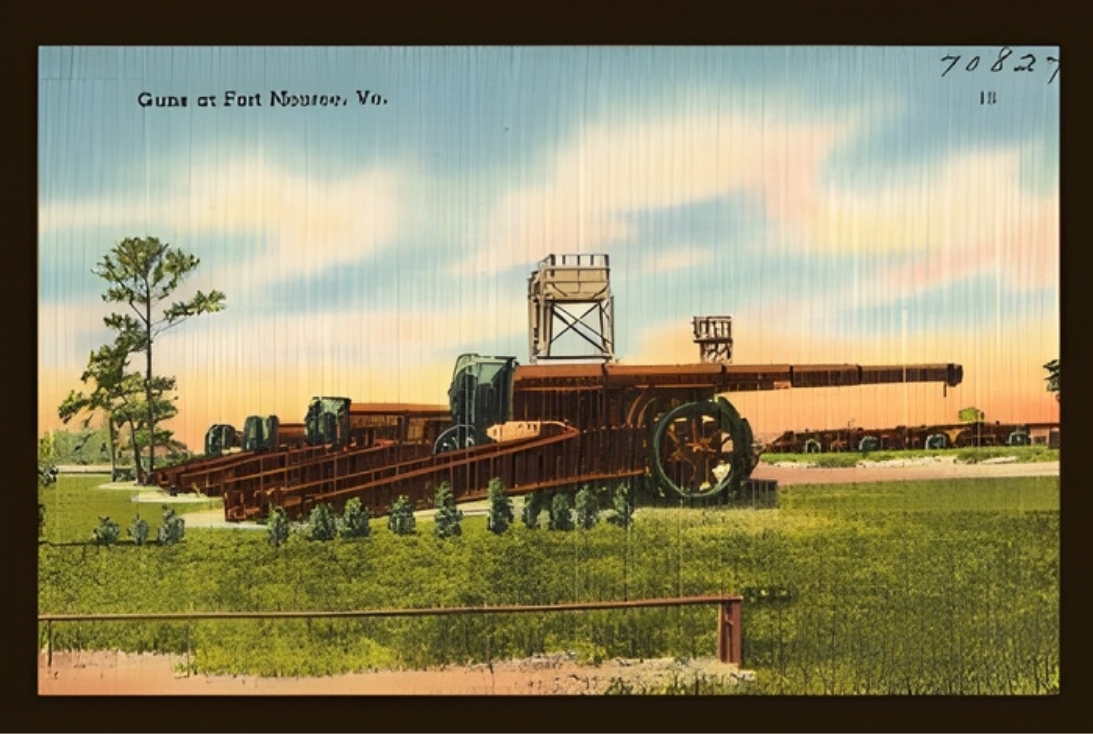
for the Coastal Artillery Corps during WWI
Bill and Lois planned to marry in February of 1918. However, when rumors spread that Bill’s Unit would soon deploy for Europe, they moved the wedding to January 24th. The Burnham family had always attended the Swedenborgian Church in Brooklyn, and so Lois and Bill were wed there, joined by a small group of family and close friends. Following the ceremony, the couple traveled to Boston to visit Bill’s mother and sister.

SE corner of Clark Street and Monroe Place, Brooklyn, NY
Photographer was Eugene L. Armbruster, 1865-1943 - Photo taken in 1922
New-York Historical Society & Library of Congress
Photo - childhood church of Lois, and where she married Bill
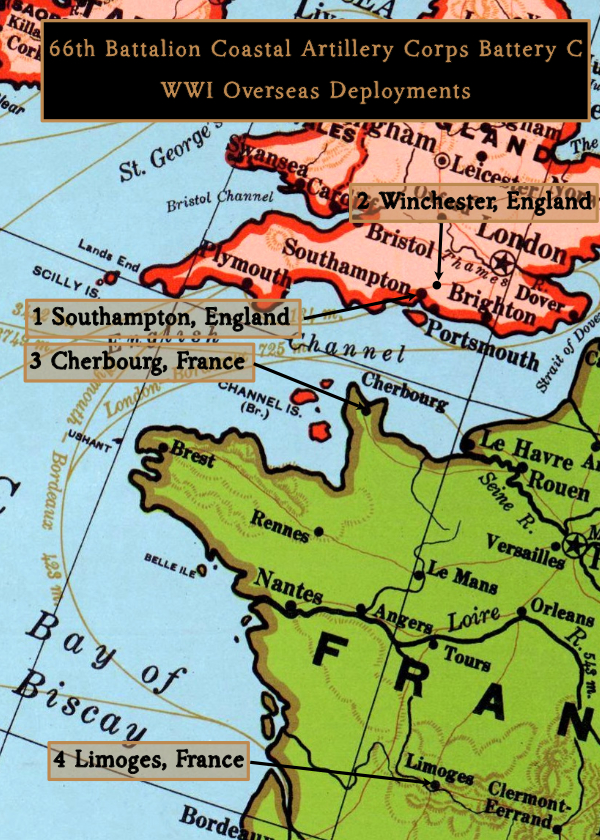
A few days later Bill rented an apartment in New Bedford, just outside the base for Lois and himself. In April, the 66th Battalion Coastal Artillery Corps Battery C, transferred to Fort Adams in Newport, Rhode Island, marking the beginning of its journey to war.
Fort Adams was used as the staging place for troops as they waited for the ships which would transport them to Europe. Bill was required to live on the base, so Lois stayed at a nearby boarding house to be close. On July 18, the ship named Lancashire departed from Boston Harbor bound for Southampton, England, with Bill and Lois returned to her family in Brooklyn. Once deployed, Bill’s location was kept secret; when he signed his letters to Lois as Billy, she knew he was in a safe place. The Battalion camped just outside of Winchester, England, preparing for their journey to France. When an epidemic spread across the camp, Battery C was held back and the rest of the Battalion left for France. This delay provided Bill a day pass which was used to explore nearby Winchester.
In August, while out walking, he entered Winchester Cathedral. As he walked down the aisle, a beam of colored light from the stained glass windows enveloped him. Moved by the beauty, he sat in silence and experienced a profound sense of peace. Upon leaving, he came across the grave of the Hampshire Grenadier and read its inscription. Years later, Bill began his Big Book story with the words he had read on this gravestone.1
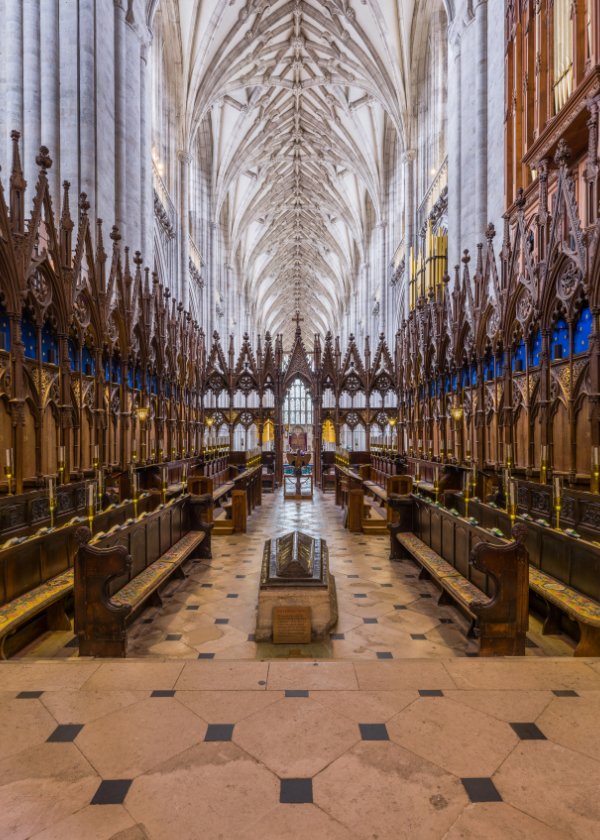
Hoping to be near Bill, Lois even volunteered for a Y.M.C.A. program that sent women trained in occupational therapy to aid injured U.S. troops. However, the Y rejected her application, deeming her childhood religious background in the Swedishbortian community an unacceptable to them as a Protestant denomination.
Battery C arrived at Cherbourg-en-Cotentin, France, on 19 August 1918. The unit was assigned to Services of Supply and moved to Limoges in west-central France. There, they rejoined the 1st Battalion. During deployment, the unit never saw combat, but during his time of service Bill had become a heavy drinker. After the Armistice, the regiment left France to return to the United States. By the end of March 1919, the entire Battalion demobilized at Camp Upton, Long Island, New York, and Bill was discharged. As a token of appreciation for his leadership, his men gave him a watch. Bill reunited with his wife at the Burnham family home at 128 Clinton Street in Brooklyn. 2
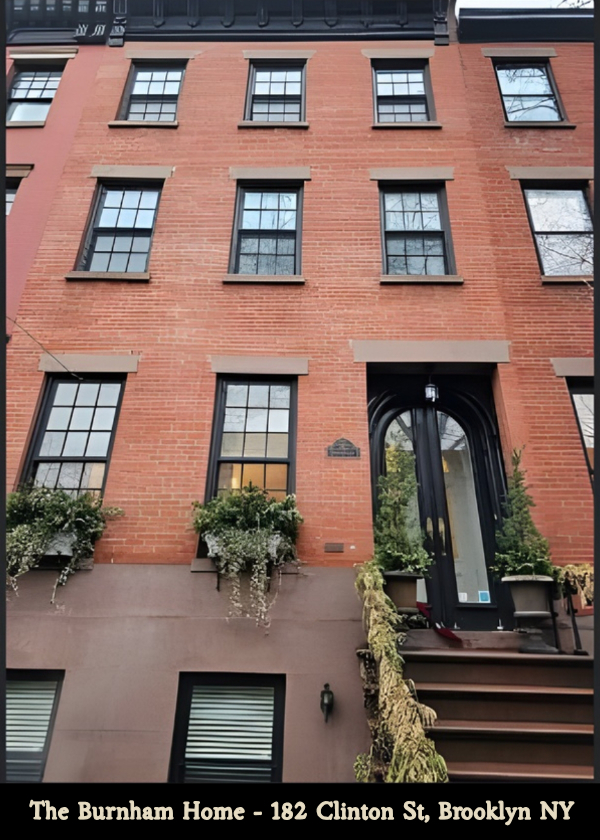
Where Bill & Lois Lived When Ebby Carried The Message
The following resources were consulted:
Quotes from the Big Book are from the public domain version, in the United States, of the 2nd edition of the book Alcoholics Anonymous. This is accessible at 12step.org
Sentence diagramming, to determine the word usage within the sentence, was performed by CoreNLP at corenlp.run. This is required in order to find the proper definition of a used word from the dictionary.
Definitions used are from the "Webster's New International Dictionary of the English Language 1930 Edition". Access to this dictionary online at Hathitrust.org
Farlex Dictionary of Idioms was used for phrases and idioms not listed in 1930 Webster's Dictionary. An idiom is a phrase or expression that has a symbolic meaning different from the literal interpretation of the words.
"164 and More - a Concordance of the Big Book and the 12 & 12" was used to refer to the multiple instances of words use within the book. Hardcopy version available for purchase and a free online version at www.164andmore.com.
"The Book That Started it All: The Original Working Manuscript of Alcoholics Anonymous" available at hazelden.org. Actual color photos of each page of the final edited draft of the "Big Book." Includes the handwritten edits, comments, debates, and discussions that produced the final text.
Historical information was gleaned from:
- "Bill W." by Robert Thomsen (1975)
- "Dr. Bob and the Good Oldtimers" by Alcoholics Anonymous (1980) publication B-8
- "Diary of Two Motorcycle Hobos by Lois Wilson (1998)
- "Ebby - The Man Who Sponsored Bill W." by Mel B. (1998)
- "Bill W." by Francis Hartigan (2000)
- "The Lois Wilson Story When Love Is Not Enough" by William G. Borchert (2005)
- "Writing the Big Book" by William Schaberg (2019)
There are eight parts of speech in the English language. The part of speech indicates how the word functions in meaning as well as grammatically within the sentence. An individual word can function as more than one part of speech when used in different circumstances. Understanding parts of speech is essential for determining the correct definition of a word when using the dictionary.
- Noun - the name of a person, place, thing, or idea. a thing (book), a person (Noah Webster), an animal (cat), a place (Omaha), a quality (softness), an idea (justice), or an action (yodeling)
- Pronoun - used in place of a noun - any of a small set of words (such as I, she, he, you, it, we, or they) in a language that are used as substitutes for nouns or noun phrases and whose referents are named or understood in the context.
- Verb - expresses action or being - jump... is... write... become - The verb in a sentence expresses action or being.
- Adjective - modifies or describes a noun or pronoun. An adjective is a word used to modify or describe a noun or a pronoun. It usually answers the question of which one, what kind, or how many. pretty... old... blue... smart (Articles [a, an, the] are usually classified as adjectives.)
- Adverb - modifies or describes a verb, an adjective, or another adverb. gently... extremely... carefully... well - An adverb describes or modifies a verb, an adjective, or another adverb, but never a noun. It usually answers the questions of when, where, how, why, under what conditions, or to what degree. Adverbs often end in -ly.
- Preposition placed before a noun or pronoun to form a phrase modifying another word in the sentence. by... with.... about... until - (by the tree, with our friends, about the book, until tomorrow) A preposition is a word placed before a noun or pronoun to form a phrase modifying another word in the sentence. Therefore a preposition is always part of a prepositional phrase. The prepositional phrase almost always functions as an adjective or as an adverb.
- Conjunction - joins words, phrases, or clauses. and... but... or... while... because - A conjunction joins words, phrases, or clauses, and indicates the relationship between the elements joined. Coordinating conjunctions connect grammatically equal elements: and, but, or, nor, for, so, yet.
- Interjection - used to express emotion. Oh!... Wow!... Oops! - An interjection is a word used to express emotion. It is often followed by an exclamation point.

|
on to page 1 |

|
jump to the top of this page |
Footnotes for this page;
1A more detail account of the historical events at Winchester, England can be found in the book "Bill W." by Robert Thomsen (1975) page 107.
266th Battalion Battery C WWI history from "Coast Artillery Organizational History, 1917-1950 Part I, Coast Artillery Regiments 1-196" by William C. Gaines